
Christmas in Medieval Times AD 500 - 1500: Recordings (A Working List)
Updates Dec. 29, 2025
2023

El cant de la Sibil.la & Draumkvedet
Mystical songs between the visible and the invisible
The great ancient mystery chants of Spain and Norway
This is a program where the Hirundo Maris ensemble delves into two mystical chants that oscillate between the visible and the invisible and are rooted in the Middle Ages. Thanks to their beauty and magic, they have been sung throughout the centuries, keeping this ancient tradition alive to our times. Hirundo Maris reconnects the north with the south through these ancient origins, but it is in the medieval and Renaissance periods that they gain strength and musical journey filled with mystery.
The Song of the Sibyl comes from antiquity, but the first musical traces can be found in the 13th century. It is the song of the Apocalypse, of the final judgment, but also the coming of a new world. It is the wise voice of a feminine figure who, with her heartrending beauty of a song, conveys hope through forgiveness.
In this program, we have chosen the first Sibyl, which will be sung in Catalan, of a more syllabic nature, found in the Cathedral of Barcelona, written down in 1415. The other Sibyl we have chosen is from Girona, written down in 1550, but that doesn't mean it wasn't sung much earlier! The Sibyl of the Cathedral of Girona is one of the most melismatic. But both Sibyls begin with an ascending fifth interval, indicating a bright, cosmic, and sacred song.
In 2010, El cant de la Sibil.la became part of the world heritage.
Hirundo Maris is proud to present their unique rendition of Draumkvedet,an enthralling Norwegian medieval ballad, in their latest album. This adaptation not only preserves the essence of the original but also enhances it with fresh musical perspectives.
Draumkvedet, or "The Dream Poem," is an enigmatic and mesmerizing piece of Norwegian folklore, often regarded as one of the country's most valuable cultural treasures. Its haunting verses tell a dream-journey to the afterlife, symbolizing themes of life, death, and redemption that resonate deeply with human experience.
In this new recording, Hirundo Maris has meticulously selected 52 verses from the ballad and brought them to life using four traditional folk melodies. These melodies have often been employed in singing this rich text, and the group has embraced them to create a connective thread with the past.
The new choral and instrumental music in this rendition has been exclusively composed by Petter Udland Johansen, a leading member of the group.
This unique version of "Draumkvedet" by Hirundo Maris stands as a homage to the medieval Norwegian culture and a testament to the limitless possibilities of music. It invites listeners to a mystical journey that transcends time, guided by the age-old melodies and fresh musical landscapes.
With heartfelt gratitude, we extend our sincere thanks to L’ensemble vocal de Saint-Maurice and their esteemed conductor, Charles Barbier.
We are also very grateful for the valuable and generous help of the great musicologist Maricarmen Gómez Muntané, a specialist in the Song of the Sibyl, with whom we have been able to work in depth and who has helped us better understand this fascinating world of the Sibyl.
This program, centered on the two mystical chants, has been carefully arranged by Hirundo Maris to take us on a journey related to winter, where the line between the visible and the invisible will be very subtle and full of mysteries.
Arianna Savall and Petter Udland Johansen, 17 august 2023, Maisprach
El Cant de la Sibil.la & Draumkvedet
Arianna Savall
2.El Cant de la Sibil.la de Barcelona: Un rey vendrà ...02:32
3.El Cant de la Sibil.la de Barcelona: Trotto02:01
4.El Cant de la Sibil.la de Barcelona: Un corn adesús sonarà ...01:38
5.El Cant de la Sibil.la de Barcelona: Choir I: Al jorn del judici ...00:35
6.El Cant de la Sibil.la de Barcelona: Lladonchs no·y haurà hom talent ...00:49
7.El Cant de la Sibil.la de Barcelona: Choir II: Al jorn del judici ...00:33
8.El Cant de la Sibil.la de Barcelona: Del murir seràn tots lurs telens ...00:1701:11
9.El Cant de la Sibil.la de Barcelona: Llos puygs e·ls plans seran ...00:36
10.El Cant de la Sibil.la de Barcelona: Quandi i oselli01:27
11.El Cant de la Sibil.la de Barcelona: Hanc hom no·ych féu res tan secret ...01:15
12.El Cant de la Sibil.la de Barcelona: Ad mortem festinamus01:46
13.El Cant de la Sibil.la de Barcelona: Llos infans qui nats no seran ...01:09
14.El Cant de la Sibil.la de Barcelona: Senyors e dones qui·ns ascoltats ...00:38
15.El Cant de la Sibil.la de Barcelona: Choir III: Al jorn del judici ...00:48
16.Draumkvedet: Instrumental I01:52
17.Draumkvedet: Vi’du me lye, eg kvea kan ...02:52
18.Draumkvedet: Ecce stella in Oriente ...01:10
19.Draumkvedet: Gamle menner og unge ...00:33
20.Draumkvedet: Choir I: Å de va Olav Åsteson ...00:22
21.Draumkvedet: Eg la me ne um joleaftan ...05:02
22.Draumkvedet: Choir II: For månen skin'e ...00:41
23.Draumkvedet: Fysste eg va i uteksti ...04:30
24.Draumkvedet: Choir III: For månen skin'e ...00:42
25.Draumkvedet: So kom eg meg at vòtno dei ...02:47
26.Draumkvedet: Instrumental II01:52
27.Draumkvedet: Kjem eg meg at pilegrimskyrkjun ...04:24
28.Draumkvedet: Choir IV: I brokksvalin ...00:22
29.Draumkvedet: Eg såg meg einom drengjen ...04:38
30.Draumkvedet: Choir V: I brokksvalin ...00:24
31.Draumkvedet: Sæl æ den i føisheimen ...03:23
32.Draumkvedet: Choir VI: Tunga talar ...00:30
33.Draumkvedet: Instrumental III01:25
34.Draumkvedet: Gamle mennar å unge ...00:49
35.Draumkvedet: Choir VII: Stå upp du Olav Åsteson ...00:35
36.El Cant de la Sibil.la de Girona: Planctus Sibyllarum02:05
37.El Cant de la Sibil.la de Girona: Refrain: Al jorn del judici ...00:28
38.El Cant de la Sibil.la de Girona: Choir I: Al jorn del judici ...00:43
39.El Cant de la Sibil.la de Girona: Un rey vindrà perpetual ...03:17
40.El Cant de la Sibil.la de Girona: Aprés se badarà molt fort ...03:20
41.El Cant de la Sibil.la de Girona: Aprés serà un fort senyal ...02:42
42.El Cant de la Sibil.la de Girona: Choir II: Al jorn del iudici ...00:36
43.El Cant de la Sibil.la de Girona: De morir serán tots son talens ...02:43
44.El Cant de la Sibil.la de Girona: Choir III: Al jorn del iudici ...00:47
45.El Cant de la Sibil.la de Girona: Aprés vindrà terriblement ...01:23
46.El Cant de la Sibil.la de Girona: Imperayritz de la ciutat joyosa01:40
47.El Cant de la Sibil.la de Girona: Los infants qui nats no seran ...02:03
48.El Cant de la Sibil.la de Girona: Mare de Déu pregau per nos ...03:32
49.El Cant de la Sibil.la de Girona: Choir IV: Al jorn del iudici ...00:37
https://carpediemrecords.com/products/el-cant-de-la-sibil-la-draumkvedet?_pos=3&_sid=d9616e939&_ss=r

2021

The Boston Camerata Releases Christmas in the Middle Ages Album
Label Description:
Drawing on a wide variety of sources, mingling liturgical Latin with French, English, Italian and Iberian vernaculars, these magnificent songs, hymns and processionals show the multitude of ways in which the birth of Christ was celebrated in medieval times. The trio of female singers is accompanied by harp, fiddle, bells and wind instruments: together they touchingly evoke all the tenderness, hope and joy of medieval Christmas songs.
2019

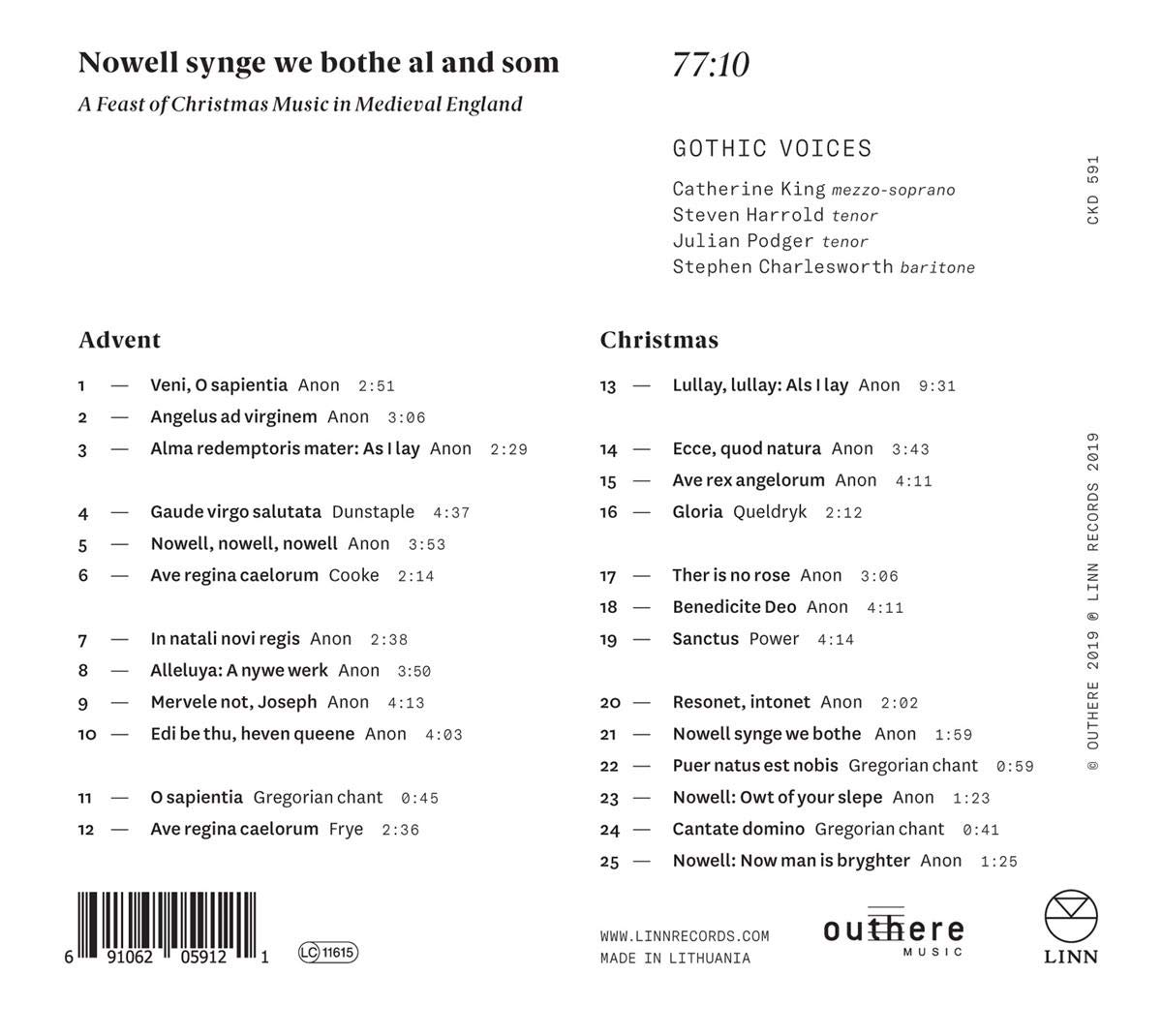
Nowell Synge we bothe and som: A Feast of Christmas Music in Medieval England
Gothic Voices
Gothic Voices reputation for the originality of its programming is cemented with its first recording of medieval Christmas music, in which Julian Podger reimagines a fifteenth-century carol evening.
Mirroring the modern practice of performing mostly music from the preceding centuries alongside some contemporary repertoire, the programme includes late medieval English carols, chant, mono-and polyphonic songs and motets for the Advent and Christmas season, focusing on Mary, her Annunciation and the birth of Jesus.
Larger-scale festive motets and mass movements by English late medieval celebrities John Dunstaple and Leonel Power also feature. The evening concludes with a summons to wake up to the significance of Christmas, with the conductus call "Resonet, intonet" introducing the carols "Nowell syng we bothe al and som" and "Nowell: Owt of your slepe" and the great Christmas chant "Puer natus est nobis," arranged here into a joyful finale. This recording has been widely anticipated since a performance of this repertoire in December 2016 was chosen by BBC Music Magazine as its number one unmissable Christmas event.
Label: Outthere Music

The Spanish 'Golden Age' witnessed an astonishing musical flowering, fully worthy of the nation's new-found preeminence on the world stage.
2 Guerrero: A Un Niño Llorando
3 Morales: Cum Natus Esset Jesus
4 Flecha: El Jubilate
5 Lobo: Agnus Dei from Missa Beata Dei Genitrix Maria

Prague has always been regarded as one of the most beautiful cities in the world. The name ‘Cor Europae’ (Heart of Europe) probably dates from the country’s early history, in the thirteenth century, when the Kingdom of Bohemia stretched from the Baltic to the Mediterranean.


This collection of early music for the Advent season provides a glimpse into the days of anticipation and hope leading up to Christmas during the late Middle Ages and the Renaissance. Pierre de La Rue spent his professional life serving some of the most influential rulers of that time, and the glorious polyphony of his Missa Conceptio tua celebrates the Immaculate Conception in a manner appropriate to the extravagant liturgy of the Habsburg-Burgundian court. The seven O Antiphons focus on the theme of Jesuss imminent arrival, while the concluding English carols centre on the Virgin Marys birth of the Christ child. Schola Antiqua of Chicago is a professional vocal ensemble dedicated exclusively to the performance of music from before the year 1600. An ensemble that executes the pre-modern repertory with sensitivity and style (Early Music America), Schola Antiqua was founded in 2000 under the artistic leadership of Calvin M. Bower (University of Notre Dame). The ensemble has recorded three albums on the Discantus label (including first recordings of music by Leonin, Du Fay, Guerrero, and Lassus).
1 O Antiphons O Sapientia with Magnificat
2 O Antiphons O Adonai
3 O Antiphons O Radix Iesse
4 O Antiphons O Clavis David
5 O Antiphons O Oriens
6 O Antiphons O Rex Gentium
7 O Antiphons O Emmanuel
8 Missa Conceptio Tua Kyrie
9 Missa Conceptio Tua Gloria
10 Missa Conceptio Tua Credo
11 Missa Conceptio Tua Sanctus
12 Plainchant: Alma Redemptoris Mater Late Medieval English Carols
13 Plainchant: Alma Redemptoris Mater There Is No Rose of Swych Vertu
14 Plainchant: Alma Redemptoris Mater Hail Mary Full of Grace
15 Plainchant: Alma Redemptoris Mater Nova Nova!
Naxos


Nowell, Nowel, Noel - on their new release, Sing thee Nowell, New York Polyphony sings of, and to, the birth of Christ in a typically sophisticated programme which fuses the ancient with the modern into a seamless whole.
Seven centuries of Christmas passes before the listener with new works composed for these performers by Michael McGlynn, Andrew Smith and John Scott alongside traditional medieval and Renaissance carols and motets by Clemens 'non Papa', Philippe Verdelot and Tomás Luis de Victoria.
The wide-ranging sequence is anchored by Richard Rodney Bennett's Five Carols, in which the sopranos Sarah Brailey and Elizabeth Baber Weaver join in celebrating 'the joyful birth' and in praising 'Mary mild', that 'maiden fair and wise'. The wondrous events related to the Christmas story and the joy they bring to mankind naturally dominate, but intimations of Christ's death on the cross also surface in the course of the disc, as in Peter Warlock's Bethlehem Down: 'they will clothe him in grave-sheets, myrrh for embalming, and wood for a crown.'
Formed in 2006, New York Polyphony has rapidly emerged as one of the leading vocal chamber ensembles, applying a distinctly modern touch to repertoire that ranges from austere medieval melodies to cutting-edge contemporary compositions. Two previous recordings for BIS have received critical acclaim, including a Grammy nomination for the 2013 release Times go by Turns, interleaving masses by Byrd and Tallis with works from the 21st century.

A very special CD for Christmas is presented by Flanders Recorder Quartet together with the young Belgian vocal ensemble Encantar and soprano Cecile Kempenaers: Christmas music from the Middle Ages and the Renaissance. Traditional melodies as well as Gregorian chant, consort songs, and chorales: this early Christmas music rediates a lot of character and color, cheerfulness and contemplation.
The large recorders, practically a “living organ,” are the perfect partners for the singers. To be heard on this CD is the world's largest recorder, a 3-meter-long sub-contrabass.
This is the Flanders Recorder Quartet's fifth production for AEOLUS, and the CD debut of the four remarkable young singers of Encantar.
Anonymus Ave stella matutina
Samuel Scheidt Gelobet seist Du, Jesu Christ
Clemens non Papa Descendit angelus Domini
Anonymus Lullay, lullay
Tomás Luis de Victoria O Regem coeli
Anonymus Born is the Babe
Anonymus Sweet was the Song
Anonymus Sweet was the Song
Michael Praetorius Summo parenti gloria
Michael Praetorius Hymnus in adventu Domini
Jacob Praetorius Christum wir sollen loben
Lambert de Sayve Quem vidistis pastores
Clemens non Papa Gabriel angelus
Alexander Agricola Magnificat
Anonymus Nowel, nowel

The Trinity Carol Roll (Trinity College, Cambridge, MS O.3.58) is the earliest source for the English polyphony carol. The thirteen works preserved in this manuscript include the patriotic ‘Agincourt’ carol, celebrating Henry V’s victory over the French in 1415, and the most famous of all early English carols ‘Ther is no rose’.
The performances on this recording offer a fresh take on medieval instrumentation, and include the gothic harp, psaltry, plectrum lute, recorder and the etherial gemshorn, while the recording itself took place in the Wren Library in Trinity College, Cambridge.
| 1 | Hail Marye Ful of Grace |
| 2 | Nowel, Nowel, Nowel |
| 3 | Alma Redemptoris Mater |
| 4 | Now May We Syngyn |
| 5 | Be Mery, Be Mery |
| 6 | Nowel Syng We |
| 7 | Deo Gracias Anglia |
| 8 | Nowel, Nowel |
| 9 | Lullay, Lullay |
| 10 | Princeps Pacis |
| 11 | Nova, Nova |
| 12 | Tibi Laus, Tibi Gloria |
| 13 | Now Make We Merthe |
| 14 | Abyde I Hope It Be the |
| 15 | Qwat Tydynges Bryngyst Thu Messager |
| 16 | Eya Martir Stephane |
| 17 | Prey for Us the Prynce of Pees |
| 18 | Ther Is No Rose of Swych Vertu |


Epiphany - from the Greek meaning "manifestation" or "appearance" - is the traditional Christian feast that celebrates the revelation of God the Son as a human being in Jesus.
1 Reges Tharsis
2 Salvator Mundi
3 Omnes de Saba
4 Epiphaniam Domino
5 Hostis Herodes Impie
6 Hostis Herodes Impie
7 Hodie Celesti Sponso
8 Mi Fe, Vengo de Belen
9 Los Reyes Siguen La'strella
10 A Un Niño Llorando

During the 17th and 18th centuries, in the heyday of the 'Baroque', the Church of France attempted to revive the old Gallican chant which had been absorbed into the great so-called 'Gregorian' repertoire. An example of this is provided by the plainchant Mass of the Nativity recorded here, a gem of its kind.
ANONYMOUS · I. Introït : Parvulus natus est nobis (5'53) · II. Kyrie eleïson (10'21) · III. Gloria in excelsis Deo (20'12) · IV. Graduel : Recordatus est Domine (2'08) · V. Alleluia : Verbum caro factus est (2'25) · VI. Prose : Votis Pater annuit (3'58) · VII. Offertoire : Hostias et oblationes (1'39) · VIII. Préface (1'44) · IX. Sanctus (6'46) · X. Motet au Saint-Sacrement : O salutaris Hostia (4'57) · XI. Agnus Dei (6'32) · XII. Communion : In hoc apparuit caritas Dei (1'45) · XIII. Ite missa est (0'22) · XIV. Deo gratias (0'27) · XV. Postludium (2'39)
https://www.harmoniamundi.com/en/albums/mass-for-christmas-day/

1 ¡O Que Nueva! 2 Introitus - Puer Natus Est 3 Kyrie Eleison 4 Gloria 5 Graduales - Viderunt Omnes 6 Niño Dios D'amor Herido 7 Mi Fe, Vengo De Belen 8 Credo 9 Pastores, Si Nos Quereis 10 Offertorium - Tui Sunt Caeli 11 ¡O Grandes Paces! 12 Sanctus-Benedictus 13 ¡O Que Plazer! 14 Agnus Dei 15 Communio - Viderunt Omnes 16 Al Resplandor D'una Estrella Label: Almaviva |


Gabriel's Message is a celebration of Advent, gathering together pieces from 13th-15th Century English manuscripts which depict the Angel Gabriel's visit to the Virgin Mary. Gabriel's Message is an anthology of Christmas past, from harsh winds to crackling fires, a peal of bells or a baby's cry, it captures the sounds of winter with both its hardships and its festivities.
1. The Angel Gabriel From Heaven Came (0:39)
2. Nowell This Is The Salutation Of Th' angel Gabriel (5:39)
3. Edi Beo Thu Hevene Quene (5:52)
4. Nowell Nowell (3:54)
5. Stella Maris Nuncuparis (2:31)
6. As I Lay Upon A Night (6:29)
7. Salve Virgo Virginum (2:32)
8. Nota (2:00)
9. Ad Rose Titulum (3:58)
10. Lullay - As I Lay On Yole Night (9:12)
11. Estampie (5:20)
12. Veni Mater Gracie - Dou Way Robin (4:03)
13. Verbum caro factum est (3:20)

"the Christmas Revels explores its own festive roots...the music is uniformly lovely...determinedly merry and bright" -- BOSTON GLOBE
What a fine racket these fiddles, recorders, sackbuts, lutes, hurdy-gurdy, bagpipes, and drums make. Light, lyrical songs and supple playing keep the mood upbeat as they recreate the time of Henry VIII and two centuries of Scottish life. The sad-eyed beauty of a Scottish tune will take your breath away, while a medley of Highland pipe tunes will give it back.
1 Blessed Be That Maid Marie
2 The Buffens
3 The Old Year Now Away Is Fled
4 The Black Alman
5 What Child Is This?
6 Pastime with Good Company
7 Courante
8 Carol of the Twelve Days
9 Deo Gratias
10 Sweet Was the Song the Virgin Sang
11 Praeludium
12 Mistress Nichols Almand
13 The Earl of Essex Galliard
14 Volta 15 Da Day Dawis
16 All Sons of Adam
17 My Lord of Marche Paven
18 Galliard
19 Lyttil Blak
20 Coulter's Candy
21 The Three Craws
22 Will Ye No' Come Back Again?
23 Blue Bonnets Pipe March/Drops of Brandy
24 Some Say the Devil's Dead
25 The Four Tradesmen
26 Ca' the Yowes
27 Niel Gow's Lamentation for the Death of His Second Wife 28 The Haughs of Cromdale
29 Medley of Scottish Reels
30 Sae Will We Yet
31 Medley of Highland Pipes Tunes
32 Rorate Coeli Desuper
Gustavus Adolphus College

1 In Festo Sanctissimi Corporis Christi: Introitus 2 In Festo Sanctissimi Corporis Christi: Graduale 3 In Festo Sanctissimi Corporis Christi: Offertorium 4 In Festo Sanctissimi Corporis Christi: Communio 5 Puer Natus in Bethlehem, in Mode 1 6 Proprium Primae Missae in Nativitate: Graduale 7 Proprium Primae Missae in Nativitate: Offertorium 8 Proprium Primae Missae in Nativitate: Communio 9 Proprium Missae in Epiphania Domini: Introitus 10 Proprium Missae in Epiphania Domini: Graduale 11 Proprium Missae in Epiphania Domini: Offertorium 12 Proprium Missae in Epiphania Domini: Communio 13 Dies Irae, Dies Illa, Sequence in Mode 1 14 In Assumptione B. Mariae Virginis: Introitus 15 In Assumptione B. Mariae Virginis: Graduale 16 In Assumptione B. Mariae Virginis: Offertorium 17 In Assumptione B. Mariae Virginis: Communio 18 Andreae Apostoli: Introitus 19 Andreae Apostoli: Graduale 20 Andreae Apostoli: Offertorium 21 Andreae Apostoli: Communio 22 Commune Unius Martyr: Introitus 23 Commune Unius Martyr: Graduale 24 Commune Unius Martyr: Offertorium 25 Commune Unius Martyr: Communio 26 Missa Aeterna Christi Munera (Mass for the Feast Fo St. John, Apostle and Evangelist) LabeL: Also |

| 1 Conditor Alme Siderum, (Hymnus) 2 De Illa Occulta Habitatione, (Responsorium) 3 O Virgo Virginum, (Antiphon) 4 Hodie Scietis, (Introitus) 5 Hodie Scietis, (Graduale) 6 Tollite Portas, (Offertorium) 7 Revelabitur Gloria Domini, (Communio) 8 Veni, Redemptor Gentium, (Hymnus) 9 Christus Natus Est Nobis, (Invitatorium) 10 Christe, Redemptor Omnium, (Hymnus) 11 Primo Tempore, (Lectio) 12 Hodie Nobis Coelorum Rex, (Responsorium 1) 13 Hodie Nobis de Coelo Pax Vera, (Responsorium 2) 14 Descendid de Coelis, (Responsorium 3) 15 Liber Generationis Jesu Christi 16 Dominus Dixit Ad Me, (Introitus) 17 Tecum Principium, (Graduale) 18 Dominus Dixit Ad Me, (Alleluja) 19 Laetabundus, (Sequenz) 20 Laetentur Coeli, (Offertorium) 21 In Splendoribus, (Communio) 22 Alma Redemptoris Mater, (Antiphon) |

1 Videte Miraculum - Thomas Tallis
2 Audivi Vocem de Caelo - John Taverner
3 Rorate Caeli Desuper (Gradualia I, 1605) - William Byrd
4 Gloria (Missa Puer Natus Est) - Tallis
5 Tollite Portas (Gradualia I) - Byrd
6 Sanctus & Benedictus (Missa Puer Natus Est) - Tallis
7 Ave Maria (Gradualia I) - Byrd
8 Agnus Dei (Missa Puer Natus Est) - Tallis
9 Ecce Virgo Concipiet (Gradualia I) - Byrd
10 Magnificat - Robert White
11 Puer Natus Est - Plainchant
12 Verbum Caro - John Sheppard

Label : Christophorus

Label: Erato Disques


| 1 PROCESSIONAL: Nun Komm der Heiden Heiland 2 Nun Komm der Heiden Heiland 3 HYMN: Wachet Auf! 4 CAROL: Puer Natus in Bethlehem 5 OFFERTORY: Ach, Mein Herre 6 CREDO: Wir glauben all 7 Dances from Terpsichore 8 GLORIA: Glori sei Gott, from PC 9 HYMN: Quem Pastores 10 ANTIPHON: Christum wir sollen loben 11 MAGNIFICAT, Parts I & II 12 CAROL: O Morning Star 13 MAGNIFICAT, Parts III & IV 14 CAROL: Lo, How a Rose E'er Blooming 15 Our Father in Heaven 16 BENEDICTION: Benedicamus aeterno Regi 17 ORGAN VOLUNTARY: Nun lob mein Seel 18 CLOSING HYMN: In dulci jubilo/Good Christian Friends, Rejoice! Label: Koch Records |

Classic FM Magazine awarded it 5 stars—its top rating—and Gramophone called it “one of the season’s best.”
1 Veni Redemptor Gentium, for Vocal Ensemble
2 Hodie Christus Natus Est (Mode 1)
3 Hodie Christus Natus Est, for 4 Voices
4 Puer Natus Est Nobis, Introit
5 Lully, Lulla, Thou Little Tiny Child, for Soloist & Chorus, Op 25B
6 Beata Viscera, Conductus for Solo Voice
7 Ave Maria Mater Dei for 4 Voices
8 Alma Redemptoris Mater
9 The Darkest Midnight in December, Carol (Irish)
10 The Fader of Heaven, for Vocal Ensemble
11 Vox in Rama Audita Est, Communion
12 Vox in Rama, Motet in 4 Voices
13 Vox in Rama Audita Est, Communion: Reprise
14 Away in a Manger
15 Ave Maria for 5 Voices
16 Coventry Carol (2): 'Lully, Lulla, Thou Little Tiny Child'
17 Ave Maria, Gratia Plena, Tractus
18 Lullay, Lullow: I Saw a Swete Semely Syght, Christmas Carol for 2 Voices
19 Mervele Noght, Josep
20 Nowell, Nowell: Dieu Vous Garde
21 Veni Redemptor Gentium, Hymn (For Advent)
22 O Magnum Misterium, Motet for 4 Voices (Satb)
23 Ecce Advenit Dominator Dominus
24 Magi Veniunt Ab Oriente
25 Nunc Dimittis, for Vocal Ensemble
26 Vox in Rama

Quiz question: when was Gregorian chant composed?
1 Introit: Parvulus natus est nobis
2 Kyrie Eleison
3 Gloria: In excelsis deo
4 Graduel: Recordatus Est Domine
5 Alleluia: Verbum Caro Factus Est
6 Prose: Votis Pater Annuit
7 Offertoire: Hostias Et Oblationes
8 Preface
9 Sanctus: Sanctus: Grand-Jeu/Sanctus/Sanctus: Plein-Jeu Du Positif/Hosanna/Bendictus: Recit...
10 Motet Au Saint-Sacrement/O Salutaris Hostia
11 Agnus Dei: Agnus Dei: Montre Du Grand-Orgue/Agnus Dei/Agnus Dei: Dialouge Cornet Du Grand-Orgue...
12 Communion: In Hoc Apparuit Caritas Dei
13 Ite Missa Est
14 Deo Gratias
15 Postludium

“A spicy Christmas feast, from a time when classic and folk music mixed. There was little difference in the popular music of the church or the tavern! Often more Chaucer than Christian… A lively record to sit back and enjoy! The attraction of the melodies and especially the exciting rhythms of Medieval music has influenced composers like Vaughan Williams and popular icons such as Ian Anderson and Jethro Tull. Many pieces are as popular today as they were centuries ago.”
– James Griffett
2 Alle Psallite
3 Portugaler
4 Angelus Ad Virginem
5 Gregorian Chant: Introitus: Puer Natus Est Nobis (In Nativitate Domini Advertiam Missam)
6 In Seculum Breve
7 Orientis Partibus
8 Ductia
9 Verbum Patris
10 E Semine Rosa
11 Alleluia Psallat
12 This Yol
13 Edi Beu Thu
14 Ecce Quod Natura
15 Nova, Nova
16 Goday My Lord Syre Christemasse
17 Danse Real
18 Beata Viscera
19 Gregorian Chant: Graduale: Viderunt Omnea (In Nativitate Domini Advertiam Missam)
20 Virgo
21 Beata Viscera
22 Gregorian Chant: Offertorium: Tui Sunt Coeli
23 Gregorian Chant: Communio: Viderunt Omnes
24 Quene Note
25 A Solis Ortus
26 Gregorian Chant: Hymnus: Aeterna Christi Munera
27 Tard Il Mio Cor
28 Ther Ys No Rose
29 Nowel, Synge We
30 Nowel, Owt of Your Slepe
31 Hayl Mary
32 Synge We to Thys Mery Cumpane
https://altocd.com/product/medieval-christmas/


This CD is divided into sections based on geography and date: eleventh-century southern France, thirteenth-century England, fourteenth-century Italy and Spain, and fifteenth-century England. This album’s sound is nicely atmospheric and resonant, and will likely to be of interest to any fan of early music, especially to anyone looking for Christmas music that extends beyond the typical carols.
1 Lux Hodie... Orientis Partibus
2 Natus Est Rex
3 Noster Cetrus Psallat Letus
4 Angelorum Lauda Digna
5 In Sapiencia
6 Benedicamus Domino
7 Ave Caro
8 Psallat Chorus
9 In Excelsis Numine
10 Angelus Ad Virginem/Gabriel, Fram Heven-Kinge
11 Ductiae (1)
12 Ductiae (2)
13 Benedicamus Domino
14 Cristo E Nato
15 Benedicamus Domino - Paolo Da Firenze
16 Ave, Die Genitrix
17 Kyrie
18 Gloria - Egardus
19 Salutiam Divotamente
20 Nowell; Dieu Vous Garde
21 Ah. My Dear Son
22 Ave Rex Angelorum
23 There Is No Rose
24 Lullay, Lullow
25 Nowell, Nowell: Tidings True
26 Nowell Sing We
27 Noel, Nowell: I Am Here, Sire Christesmas
28 Abide
29 The Boares Head

Release on CD of a record disc.
1 From Piae Cantiones: Personent Hodie
2 From Piae Cantiones: In Dulci Iubilo
3 From Piae Cantiones: Omnis Mundus Incundetur
4 From Piae Cantiones: Verbum Caro
5 From Piae Cantiones: Gaudete
6 From Piae Cantiones: Iesus Delcis Memoria
7 From Piae Cantiones: Iesus Christus Nostra Salus
8 From Piae Cantiones: Scribere Proposui
9 From Piae Cantiones: In Stadio Laboris
10 From Piae Cantiones: In Vernali Tempore
11 From Piae Cantiones: Tempus Adest Floridum
12 Saltarello
13 Nel Boscho Senza Folglie
14 Drinking Canon
15 Es Fur Ein Pawr
16 Vasame Y Abracame
17 Dizen A Mi
18 Falalalan
19 La Quinte Estampie Reale
20 Under Den Linden
21 Vitrum Nostrum Goloriousm
22 Sauff Aus Und Machs Nit Lang
23 Es Wollt Ein Jager Jagen
24 Elslein, Lieb(st)ess Elselein 1: Monophonic Presentation/2-Part Setting From Georg Rhaw's...
25 Galliarde 'Le Tout'
26 Mir Ist Ein Feins Brauns Maidelein
27 Es Gieng Guot Troscher
28 Basse Danse 'Mon Desir'
29 Fine Knacks For Ladies
30 Wolseys WIlde
31 Margot, Labourez Les Vignes
32 So Trinken Wir Alle
33 Al Vol

Christmas songs vary greatly in inspiration and tone. Zefiro Torna here presents a choice selection of Western European Christmas songs from the Middle Ages and the Renaissance, with hymns, motets, carols and songs from well-known and anonymous masters in combination with pastoral and folk songs from England, Flanders, Naples, Catalonia and Provence.
The ensemble Zefiro Torna was founded in 1996. The group is formed by talented musicians, who studied at the conservatories of Lyon, The Hague, Brussels and Louvain. They work with the Huelgas Ensemble, Collegium Vocale, Capilla Flamenca, Het muziek Lod and others. They quickly left their mark on the current music scene, their programmes combining authenticity with originality, connecting with other cultures and fusing with modern music and theatre. Their success has led to numerous concert tours, appearances at important international music festivals and recordings. A first CD 'Mermaphilia' was released in November 2002 on the Eufoda label.


1 Third Christmas Mass: Introit: Puer Natus Est Nobis
2 Third Christmas Mass: Kyrie Altissime
3 Third Christmas Mass: Gloria II
4 Third Christmas Mass: Collect: Concede Quaesumus
5 Third Christmas Mass: Epistle: Multifariam
6 Third Christmas Mass: Gradual: Viderunt Omnes
7 Third Christmas Mass: Alleluia: Dies Sanctificatus
8 Third Christmas Mass: Gospel: In Principio
9 Third Christmas Mass: Credo I
10 Third Christmas Mass: Offertory: Tui Sunt Caeli
11 Third Christmas Mass: Secret: Oblata, Domine
12 Third Christmas Mass: Preface: Quia Per Incarnati
13 Third Christmas Mass: Sanctus III
14 Third Christmas Mass: Doxology: Per Quem Haec
15 Third Christmas Mass: Lord's Prayer: Pater Noster
16 Third Christmas Mass: Pax Domini
17 Third Christmas Mass: Agnus Dei
18 Third Christmas Mass: Communion: Viderunt Omnes
19 Third Christmas Mass: Postcommunion: Praesta Quaesumus
20 Third Christmas Mass: Ite, Missa Est
Deutsche Grammophon

| 1 Christe redemptor (Winchester Troper) 2 Quem Iohannes (Winchester Troper) 3 Alleluia V. Dies sanctificatus (Winchester Troper) 4 O primus homo corruit (Aquitanian) 5 Lux refulget (Aquitanian) 6 Annus renascitur (Anonymous) 7 De quan au'on peut (Anonymous) 8 Tout mon desir (Arnold de Lantins) 9 Ce jour de l'an (Guillaume Dufay) 10 Clangat tuba (Ritson MS) 11 Ave rex angelorum (Egerton MS) 12 Eya, martyr Stephane (Anonymous) 13 Vox in Rama (Clemens non Papa) 14 Lullay, Lullow: I saw a swete semely syght (Ritson MS) 15 O admirabile commercium (Loyset Compere) 16 Pastores loquebantur (Clemens non Papa) 17 Noel, noel, noel (Antoine Busnois) 18 Noe, noe, noe (Antoine Brumel) 19 Nato canunt omnia (Antoine Brumel)  |

"You will be rewarded by this intelligent anthology, which no collector of early music can afford to miss." -- AMERICAN RECORD GUIDE
Although subtitled "Music and Carols for a medieval Christmas" there is nothing in this disc that makes it unsuitable for use at other times of the year.
The repertoire is made of some of the earliest surviving pieces of polyphonic music, centred around the great four-voiced ‘Viderunt Omnes’ of Perotin - the first work of western music for which we know the occasion of composition (Christmas 1198 at Notre Dame de Paris).
Of course this sort of repertoire, sung by an all-male quartet of countertenor, 2 tenors and a baritone, is always going to draw comparison with the Hilliard Ensemble, which group has also recorded much of this repertoire. In general the Orlando Consort stands up well - their intonation and blend of voices being uniformly good.
Personally this reviewer finds the sound of Robert Harre Jones rather strained in places (especially in ‘O nobilis nativitas’) and thus less pleasing on the ear than David James of the Hilliards, but the tenors blend effectively - most tellingly in some of the passages of "voice exchange" as in ‘Flos regalis’. (Sample 1).
In general, the performances are delivered in a forthright, and somewhat ‘masculine’ style with strong emphasis on forward momentum.
Sometimes this leads to rather square rhythms and can tend towards making the programme a touch relentless, but on the other hand, in active pieces of ‘hockett’ (the notes in a melody rapidly alternated between two voices) such as ‘Huic et placuit’, this format is most effective. (Sample 2).
The centrepiece of the disc is Perotin’s ‘Viderunt Omnes’ and this massive work really tests any vocal group. At 10’24" this version is over a minute shorter than the Hilliard Ensemble’s recording from 1988 and the rapid tempo comes as something of a surprise at the outset.
The lowest part of this work is a sustained drone and baritone Donald Grieg is on his own on this line. Often this part is taken by two singers so that they can alternate breaths, a feature not possible here. The stamina is impressive, but perhaps the balance is somewhat top-heavy as a result.
However, the cumulative feel of the long passages of florid writing, gradually rising in pitch with each new section, is dramatic and enjoyable. The change of colour that occurs as each section introduces a new vowel sound adds to the sense of growth and variety. (Sample 3).
This reviewer has often remarked on un-necessarily close microphone placement that seems to be fashionable at various times, and this disc suffers here. The choice to record in a studio seems odd for this repertoire. The consort sounds like they are singing in a small room, the sort of space for which Perotin at least was not intending his music. While this space, and the close microphone placement, add to the clarity, the recording looses much atmosphere and allows several intrusive breaths to be clearly heard. The reverb sounds like it came out of a packet and does nothing at all to add any "bloom" to the sound of the group, as would occur with a naturally resonant acoustic. Given the care that has been put into aspects such as correct medieval pronunciation, the choice not to use a medieval acoustic to record seems hard to support.
Peter Wells
France
1. Novus annus hodie (anon) 2’15"
2. Ut iam cessit (anon) 1’30"
3. Fulget dies celebris (anon) 2’48"
4. Vetus abit littera (anon) 3’54"
5. Procedenti puero (anon) 2’48"
6. Mater Dei salus rei (anon) 3’49"
7. In sompnis mira (anon) 0’50"
8. Huic et placuit (anon) 1’31"
9. Viderunt omnes (Perotin) 10’24"
England
10. Angelus ad virginem (anon) 3’35"
11. Flos regalis (anon) 4’23"
12. Beata viscera (anon) 1’23"
13. Orientis partibus (anon) 1’58"
14. Salve sancta parens (anon) 1’50"
15. Virgo Maria (anon) 3’47"
16. Edi beo thu (anon) 2’25"
17. Super te Jerusalem (anon) 1’11"
18. O Nobilis nativitas (anon) 1’10"
19. There is no rose (anon) 3’43"
20 St Thomas honour we (anon) 4’11"
21. Nowell, Nowell: The boarë’s head (Smert) 4’47"
 The Orlando Consort:
 Robert Harre Jones (countertenor); Charles Daniels (tenor); Angus Smith (tenor);
Donald Grieg (baritone)
Recordings made in Aosis Studio, Camden Town, London on 26 & 27 Feb 1990
METRONOME ‘TREASURY OF MUSIC’ MET CD 1001-01 [65.35]

A Romanesque Christmas. With Marcel Pérès and Ensemble Organum, relive Mass for Christmas Day as it was sung in the prestigious setting of the School of Notre Dame in Paris, the cradle of western polyphony.
ANONYMOUS
· Introït tropé "Puer natus est" (5'59)
· Kyrie (2'11)
· Graduel "Viderunt omnes" (organum) (7'43)
· Alleluia "Dies sanctificatus" (organum) (7'49)
· Evangile : Prologue de saint Jean (2'50)
· Offertoire "Tui sunt coeli" (8'17)
· Préface "Dominus vobiscum" (1'55)
· Sanctus (organum) (4'10)
· Agnus Dei (0'52)
· Communion "Viderunt omnes" - Ps. 97 (3'53)
· Ite missa est - Deo gratias (organum) (4'03)
https://www.harmoniamundi.com/en/albums/ecole-de-notre-dame-12th-13th-centuries/

Medieval motets honoring Bohemia's "Good King Wenceslas" (St. Vaclave) and Poland's St. Stansilaus. "Carols" from the time of patriot Jan Hus, early polyphony from the Codex "Specialnik" celebrating the Nativity. Plus, the only extant Czech medieval dance, and the "Messe de Notre Dame" by Guillaume de Machaut, celebrated French poet/composer and Secretary to the King of Bohemia. Men's voices and instruments.
1 Alleluia (Mikolaj Radomski, FL. 1420-30)
2 Jesu Kriste (Czech, 13th Century)
3 Ave Regina Caelorum (Codex Specialnik, Before 1500)
4 Svaty Vaclave (Czech 13th Century)
5 Nas Mily Svaty Vaclave (Codex Specialnik)
6 Magnificat Anima Mea Dominum (Radomski)
7 Vizmez Pacholicka (Czech, 13th Century)
8 Flosculum Amenitatis (Codex Specialnik)
9 Breve Regnum (Polish, Early 15th Century)
10 Angelus Ad Virginem Missus (Polish, 15th Century)
11 Czaldy Waldy (Czech, Late 14th Century)
12 Vzdajmez Chvalu (Codex Specialnik)
13 Nobis Est Natus Hodie (Codex Specialnik)
14 Omnia Beneficia (Polish, Late 12th Century)
15 Ortus de Polonia (Polish, 13th Century)
16 Gaude, Mater Polonia (Polish, 13th Century)
17 Kyrie Eleison - la Messe de Nostre Dame (Guillaume de Machaut, 1
18 Gloria in Excelsis Deo - la Messe de Nostre Dame (Machaut)
19 Ja Falla (Czech, 14th Century)
20 Credo in Unum Deum - la Messe de Nostre Dame (Machaut)
21 Tant Plus Vos Voye (Czech, 14th Century)
22 Sanctus - la Messe de Nostre Dame (Machaut)
23 Agnus Dei - la Messe de Nostre Dame (Machaut)
24 Ite Missa Est - la Messe de Nostre Dame (Machaut)

This recording recreates a Vespers (evening) service for Christmas as it might have sounded in a large north German church in the early 17th century. In this recording, the Toronto Consort undertakes one of it's most ambitious projects ever recreating. Marquis.2005.
1 Opening Hymn: "Geborn ist Gottes Sohnelein"
2 The Ten Commandments: "Die zehen Gebot"
3 Credo: "Wir glauben all an einen Gott"
4 Gospel Reading: "So sschreibt der heilige Lucas"
5 Jubilate Domino (Psalm 98)
6 The Lord's Prayer: "Vater unser in dem Himmel"
7 Humnum de tempore: "Der neugebornen Kindelein"
8 Antiphon: "Chritum unsern Heiland"
9 Magnificat, Part I: "Meine Seel erhebt den Herren"
10 Carol: "Ein Kind geborn zu Bethlehem"
11 Magnificat, Part II: "Denn er hat große Ding an mir getan"
12 Carol: "Freut euch, ihr lieben Christen"
13 Magnificat, Part III: "Er stoßet die Gewaltigen vom Stuhl"
14 Carol: "Von Himmel hoch"
15 Magnificat, Part IV: "Wie er geredt hat unsern Vatern"
16 Carol: "Joseph lieber, Joseph mein"
17 Collect: "Der Herr sei mit euch"
18 Blessing: "Benedicamus aeterno Regi"
19 Closing Hymn: "In dulci jubilo"


1 Glocken (Kath. Dom St. Eberhard, Stuttgart)
2 Andreas Hammerschmidt: Machet Die Tore Weit
3 Friedrich Silcher: Macht Hoch Die TÜR
4 Hans Lang: O Heiland, Reiß Die Himmel Auf
5 Andreas Hammerschmidt: Alleluja! Freuet Euch, Ihr Christen Alle
6 Bartholomäus Gesius: Nun Jauchzet, All Ihr Frommen
7 Günther Raphael: Maria Durch Ein Dornwald Ging
8 Leonhard Schröter: Freut Euch, Ihr Lieben Christen
9 Michael Praetorius: Es Ist Ein Ros Entsprungen
10 Johannes Eccard: Vom Himmel Hoch, Da Komm Ich Her
11 Sethus Calvisius: Gloria in Excelsis Deo
12 Sethus Calvisius: Freut Euch Und Jubiliert
13 Carl Riedel: Kommet, Ihr Hirten
14 Johannes Ecard: Ich Steh An Deiner Krippen Hier
15 Friedemann Keck: Adeste Fideles
16 Peter Cornelius: Drei Kön'ge Wandern Aus Morgenland
17 Heinrich SCHÜTZ: Das Ist Je Gewißlich Wahr
18 Glocken


Christmas music from the Mediaeval to the Renaissance, evoking the Christian mystery of the season in past times, and the ancient celebration of the turning of the year, drawn from the abbeys, churches and marketplaces of late Mediaeval England. Rumbustious celebration and quiet devotion on one disc, with The Sixteen's usual superb singers augmented by mediaeval violin, harp, lute and drum.
1 Verbum Caro (Chant)
2 Salutation Carol
3 Nowell Sing We, Both All and Some
4 Gaudete
5 Hail Mary Full of Grace
6 Gloria in Excelsis (Sheppard)
7 There Is No Rose
8 Nowell, Nowell: Out of Your Sleep
9 Remember O Thou Man
10 Quid Petis, O Fili? (Pygott)
11 Sweet Was the Song
12 Lullaby My Sweet Little Baby (Byrd)
13 Ave Rex Angelorum
14 Drive the Cold Winter Away
15 Nowell, Nowell: The Boares Head
16 The Old Year Now Has Passed Away
17 Angelus Ad Virginem
18 Nowell, Nowell: Dieu Vous Garde
19 Make We Joy
20 Verbum Caro (Sheppard)


The small repertoire of surviving medieval Italian praise songs, or LAUDE , was first brought to modern attention in the late 19th century by the German scholar Friedrich Ludwig. Ludwig and Guido Adler both published selections from a beautifully copied collection of these songs, the Florentine Laudario.
This collection and the Cortona Laudario are the only two large collections of laude that survive complete with their musical notation. This recording features selections from these vocal editions. To complement the laude, several instrumental works from late 14th and early 15th century polyphony, and from the Faenza codex, have been featured as well.
TREFOIL is a trio of singer-instrumentalists long active in early music, with experience in such ensembles as Concert Royal, Les Arts Florissants, New York's Ensemble for Early Music, Pomerium, Clarion Music Society, Piffaro, My Lord Chamberlain's Consort, and other groups.
The trio debuted in New York and Philadelphia early in 2000 with a program of 14th century French ars subtilior song. Trefoil has appeared in concerts and master classes at The Cloisters, Temple University, Vassar College, Middlebury College, the Vermont Millennium Arts Festival, the Museum Series of Providence, Boston College, the Currier Museum of Art in Manchester, NH, the Nighborhood Music School in New Haven, the 2002 Amherst Early Music Festival, and the 37th Annual International Congress on Medieval Studies at Kalamazoo. The trio has also amde a series of joint appearances with the Folger Concert in Washington D.C.
| 1 Gloria 2 Ortorum Virentium / Virga Yesse / Victimae Paschali Laudes 3 Da Ciel Venne Messo Novello 4 Aquila Altera, Madrigal 5 Regina Pretiosa 6 Sovrana Si NÉ Sembianti 7 Ave Maris Stella, Intabulation for Keyboard 8 Sanctus 9 Stella Nuova 10 Christo È Nato 11 Ave Stella Matutina (Sienna Convent of Santa Maria Dei Servi) 12 Puer Natus in Bethlehem (Biblioteca Estense, Modena, Ms. M.5.24) 13 Co la Madre Del Beato 14 Nova Stella Apparita 15 Gloria in Excelsis |

1 Pastime with Good Company
2 Coventry Carol
3 Rorate Coeli
4 Consort No. 3
5 Christe Jesu, Pastor Bone
6 Consort No. 3
7 This Is the Record of John
8 Ave Maria
9 Remember, O Thou Man
10 Consort No. 12
11 While Shepherds Watched
12 From Virgin Pure This Day Did Spring
13 Consort No. 2
14 Laudate Nomen
15 O Nata Lux
16 Magnificat a 4
17 Sweet Was the Song the Virgin Sung
18 Quid Petis O Fili
19 Consort No. 13
20 Hosanna to the Son of David


| 1 While Shepherds Watched Their Flocks By Night (Tune: Winchester) 2 We Three Kings of Orient Are 3 I Wonder As I Wander 4 Qui Creavit Coelum 5 There Is No Rose of Such Virtue (English) 6 Sonata for 3 Trumpets (After "Joseph, Lieber Joseph Mein") 7 All Hayle to the Days 8 Letabundus 9 There Is No Rose, for Chorus, Op 14 10 Quelle Est Cette Odeur Agr Able? (Whence Is That Goodly Fragrance?) (FR 11 Lullay Thou Tiny Little Child 12 Procendenti Puero-Eya! Novus Anns Est 13 Sonata for 5 Trumpets (After "In Dulci Jubilo") 14 The Lord at First Did Adam Make 15 O Du FR Hliche, O Du Selige, Gnadenbringende Weihnachtszeit, Carol (Tun 16 Lullay, Lullay: As I Lay on Yooles Night 17 Hark! the Herald Angels Sing (Adapted By w. H. Cummings from Mendelssohn |
 Early Music New York's program of seasonal repertoire is a Sold-Out holiday tradition. Recorded in the great Cathedral of Saint John the Divine, New York City, A Medieval Christmas features lyric songs - sacred and secular - by Hildegard von Bingen, Perotin, von Reuenthal and anonymous composers from the schools of Notre Dame and St. Martial - gloriously sung and deftly played by EM/NY's Artists in Residence. Angelus ad virginem (the song Chaucer referred to in The Canterbury Tales ), angelic Hildegard chant, earthy 13th-century Italian laude and spirited Spanish cantigas illuminate a treasury of joyous celebration. Artists: John Alston - bass; Marshall Coid - countertenor, vielle; Todd Frizzell - tenor, symphonia; Wayne Hankin - winds, tenor; Wolodymyr Smishkewych - tenor, percussion; Jon Szabo - baritone, vielle 1 Rex Virginum Amator - New York's Ensemble For Early Music 2 Rex virginum amator 3 "Nota" 4 Angelus ad virginem 5 Perotin, c.1200: Beata viscera 6 Saint Martial School, late 11th century: Annus Novus in gaudio 7 Hildegard von Bingen, 1098-1179: "De Innocentibus" 8 Niedhart von Reuenthal, c. 1190-c.1240: "Minnesang" 9 Notre Dame School, c.1200: Notre Dame School, c.1200 10 Exultemus et letemur/Gaudens in Domino 11 Alfonso el Sabio, 1221-1284: Cantigas de Santa Maria-Galicia: Como poden, Muit'amar, Tan beeyta, Maravillosos 12 Llibre Vermell, 14th century: Polorum regina-Catalonia 13 Notre Dame School, c.1200: In natali summi Regis 14 Orientis partibus 15 Verbum patris humanatur 16 Late 13-14th centuries: Laude novella 17 Verbus caro factum est 18 Verbum patris hodie 19 "Alleluya" 20 Stella nuova 21 "Saltarello" |

No one has recorded more innovative Christmas anthologies than Andrew Parrott--and this disc is no exception. The Promise of Ages presents a collection of wonderful seasonal music arranged for women's voices (all arrangements were either made or sanctioned by the composers).
1 Hark! The Herald Angels Sing
2 Nos Galan (Deck the Hall)
3 Lullay, Thou Tiny Little Child
4 Ther Is No Rose of Swych Vertu
5 I Sing of a Maiden
6 There Is No Rose from "A Ceremony of Carols"
7 O magnum mysterium (Responsory at Matins for Christmas Day)
8 Song of the Nuns of Chester "Qui creavit celum" verses 1-3
9 The Fader of Heven (ca. 1450 mystery play)
10 Song of the Nuns of Chester "Lactat mater Domini" verses 4-6
11 O magnum mysterium (Responsory at Matins for Christmas Day)
12 Lullay, Lullow: I Saw a Swete Semly Syght
13 I Wonder as I Wander - Emily van Evera
14 Staines Morris (Blessed be that maid Marie)
15 Hayl, Mary, Ful of Grace
16 The Seven Joys of Mary
17 Illuminare, Jerusalem
18 Good People All, This Christmastide
19 Sing We the Virgin Mary
20 In Bethlehem City - New London Chamber Choir
21 Christmas Eve
22 Hodie Christus natus est (Antiphon from Chester Processional)
23 Jesu, Thou the Virgin-born
24 As Dew in Aprille from " A Ceremony of Carols"
25 Lo! he Comes, with Clouds Descending - New London Chamber Choir

1 Gaudete
2 Patapan
3 Il est ne le divin enfant
4 Christmas Eve
5 Green Growth the Holly
6 Mors Vitae Propitia
7 Quem Pastores
8 The Truth from Above
9 Christchurch Bells
10 Judasz and Wenceslas
11 Journey of the Magi
12 In Dulci Jubilo
13 Personent Hodie
14 Nous Voici dans la Ville
15 Noel Nouvelet
16 Coventry Carol
17 The Holly and the Ivy
18 Hail Mary Full of Grace
19 Sir Christèmas
20 Masters in this Hall


| 1 Dulci dignum melodia - Sequentia 2 Mundo salus gracie - Sequentia 3 Clara sonent organa - William Hite 4 Noster cetus psallat letus - Stephen Grant 5 Virginis in gremio - Sequentia 6 Iudicii signum - Sequentia 7 Instrumental Piece - Sequentia 8 Alleluia! Iustus ut palma florebit - Sequentia 9 Quam felix cubiculum - William Sharp 10 Uterus hodie - William Hite 11 Iubilemus, exultemus - Pamela Dellal 12 Descendit de celis - William Hite 13 Gaudia debita - Stephen Grant 14 Natus est rex - William Hite 15 Instrumental piece - Robert Mealy 16 De monte lapis scinditur - William Sharp 17 O Maria, Deu maire - Sequentia 18 Plebs domini - William Sharp Label: Sony Classical |


A traveller in the Middle Ages, whether pilgrim, crusader, messenger, cleric, student, beggar, merchant, king or Pope, was faced with dangers and difficulties along the road which we could barely imagine today. While this was especially true of journeys of some distance, into familiar territory, such travel was nevertheless common for a variety of reasons. We will concern ourselves here with travel to the Holy Land. For some people the journey was penance for a crime, others were motivated by deeply religious conviction, and still others were mainly interested in acquiring relics to bring home.
The relationship that developed between Europeans and non-Europeans through foreign commerce contributed greatly to the expansion of the travel routes. Trading in spices, perfumes, incense, narcotics and aphrodisiacs provided for centuries of contact between the Christian and the Islamic world. A negative aspect of this was the smugglers who sometimes disguised themselves as pilgrims. According to reports of the time, silkworm eggs were being smuggled from China to Jerusalem or, secret messages were hidden in pilgrim staffs. Because of this, anyone dressed as a pilgrim could be suspected of spying, subversion or dealing in contraband. So it was that Saint Coloman, while on a pilgrimage from England to the Holy Land, was hanged as a spy near Vienna.
While early pilgrimages, between the fourth and seventh centuries were thought of as a journey into penitence and solitude, or as a final destination in seeking a sanctified death, a radical change in philosophy took place when organized tours to the Holy Land, whatever Crusades or group pilgrimages, began. Now, rather than dying in the Holy Land, the lucky pilgrim who reached his goal was thought to be rewarded by God with earthly and heavenly riches, which he could then bring home. A pilgrimage no longer meant the end of one's life - it could even be repeated.
Maps were available for pilgrims. In extant maps of the Orient from the high Middle Ages, Jerusalem is pictured as the centre of the holy experience; the known continents of the time, Europe, Asia and Africa, are pictured surrounding it.
As early as the late fifteenth century, pilgrimages to the Holy Land, most by sea, were well-planned tours of differing class fares, with interpreters, tour guides, and phrasebooks, according to the 1484 travel report of the Canon of Mainze, Bernhard von Breydenbach. While these journeys eventually became routine, the ever-present obstacles of wheather, disease, robbery, etc., could not be overlooked: it was usual to expect a pilgrimage to take an entire year.
Especially complicated was the land route, opened up after the christianisation of Hungary around 1000 A.D., which led through Hungary, Croatia, Macedonia, Bulgaria, Turkey and Syria on its way to Palestine. One was expected to carry \gifts" to appease the local authorities, who would detain a traveller along his way. Along this route travellers encountered cultures completely foreign to them, which had developed from and been influenced by a variety of unfamiliar styles and traditions.
Every pilgrim who wanted to return home safely needed to have some facility with Latin, Greek, and Arabic. In Eastern Europe he could get by with a mixture of rudimentary Hebrew and Aramaic, as well as with words from German, French (Franconian) and Italian dialects. Where words failed, sign languages, gestures and music helped. Musical talent was often useful in the search for food and lodging along the way, and was offered as thanks, as a symbol of gratitude and honour. Reports tell of a traveller who was a frequent or long-term guest in a place being given a parting dinner which included a complete musical programme. This is one of the ways that travellers came into contact with unknown and exotic musical practices.
About a century after the founding of Islam, Sufism was developed, spawning a new epoch of the classical Arabic school. The Sufi and Dervish orders believed that only those who understood "how to hear music" could experience higher truth through spiritual ecstasy.
Reports of people who died while in an ecstatic trance, inspired by listening to music, are not uncommon in Arabic literature. The music responsible for such rapture is based on a modal system using untempered intervals. Each melody has its own scale, pitch and range. A modern Mevlevi Orchestra is made up of singers and instrumentalists; flutes and drums accompany the dance of the Whirling Dervishes. The selections Dinarezade and Mevlana are examples of melodies that invite the listener to spend time with the music, enough to absorb and feel its full effect.
This recording offers a musical journey from England, the most western country and launching point of the first Crusade, through France, Germany, Eastern Europe, as far east as Syria. The musical selections from Europe are thematically Christmas art-songs; the selections from the Balkans and the Near East are traditional, meaning, with the exception of the Sufi music, that it is popular music, rather than art music. As is usual with popular music, the melodies were not, or were only partially, notated. Information about performance practice is obtained only from secondary sources, such as travel reports and iconography. This music was orally transmitted, slowly changing over generations, before it was, only recently, written down, within the last few centuries. It is therefore not surprising to encounter different versions of the same piece of music. The instruments played on this recording correspond to those known to have been used between 1200 and 1500. It is interesting to note that many traditional instruments of the Orient, such as the oud, kaval, gaida, chalumeau and various percussion instruments, remain virtually unchanged and continue to be used in traditional music today.
2 Edi Be Thu, Heven-Queene - Bernhard Landauer/Marco Ambrosini/Thomas Wimmer/ 3 Nevestinko Oro - Michael Posch/Marco Ambrosini/Peter Rabanser/Katharina Dustmann 4 Beata Progenies - Bernhard Landauer/Michael Posch/Marco Ambrosini/Riccardo Delfino/Wolfgang Reithofer 5 Mari Stanko - Ellen Santaniello/Michael Posch/Marco Ambrosini/Riccardo Delfino/Thomas Wimmer/Peter Rabanser... 6 Sei Willekommen Herre Christ - Bernhard Landauer/Michael Posch/Marco Ambrosini/Riccardo Delfino/Thomas Wimmer 7 Bog Se Rodi Va Betleme - Ellen Santaniello/Michael Posch/Marco Ambrosini/Thomas Wimmer/Peter Rabanser 8 Koleda Na Bozic - Michael Posch/Marco Ambrosini/Peter Rabanser 9 Kod Betlehema - Ellen Santaniello/Bernhard Landauer/Michael Posch/Marco Ambrosini/Riccardo Delfino/Thomas Wimmer... 10 Koleda Na Bozic - Riccardo Delfino/Katharina Dustmann 11 Angelus Ad Virginem - Bernhard Landauer/Michael Posch/Marco Ambrosini/Riccardo Delfino/Thomas Wimmer/Wolfgang Reithofer... 12 D - Riccardo Delfino/Peter Rabanser/Katharina Dustmann 13 Quinte Estampie Real - Michael Posch/Marco Ambrosini/Riccardo Delfino/Thomas Wimmer/Peter Rabanser/Katharina Dustmann... 14 Urbs Beata Ierusalem - Bernhard Landauer/Marco Ambrosini/Riccardo Delfino/Thomas Wimmer 15 Mevl - Ellen Santaniello/Michael Posch/Marco Ambrosini/Riccardo Delfino/Thomas Wimmer/Peter Rabanser... Naxos  |

Ancient Noels:An INDIE finalist for "Best Seasonal Album of the Year" ( and listed in BILLBOARD magazine)Ancient carols, Renaissance rhythms and haunting medieval hymns bring to life images of desert landscapes, stone monasteries and the origins of Chrismas. Maggie Sansone on hammered dulcimer with members of Ensemble Galilei: Marcia Diehl on recorder, bowed psaltery and pennywhistle; Jim Brooks on recorder and concertina; Sue Richards on Celtic harp; Carolyn Surrick on treble viol & bass viola da gamba; and special guests Bonnie Rideout on Scottish fiddle, Zan McLeod on cittern and guitar and Ben Harms on hand drums and medieval tambourine.
Includes: Basque and Galician carols from Spain, medieval Dutch & French carols, and Renaissance tunes by 16th century master Tilman Susato.
1 Cantiga de Santa Maria, No. 48
2 Gloucestershire Wassail/Tomorrow Will Be My Dancing Day/The Sussex Ca
3 Hoboekentanz/Schafertanz
4 O Bethlehem/Bethlehem's Stall/A Maiden Was Adoring God, the Lord/Grea
5 Bellman's Song
6 Truth Sent from Above
7 Nowell, Nowell: Tidings True/Riu, Riu, Chiu
8 I Must Go Gather Comfort/There Was a Maid So Lovely/When Judah's Loya
9 Cantiga, a Madre Do Que Livrou
10 Whenas the Rose of Jericho/A Year Begins of Joy and Grace/To Us a Lit
11 Donkey's Carol/The Friendly Beasts
12 Here Betwixt Ass and Oxen Mild/The Golden Carol
13 In the Bleak Midwinter

- Antiphon: Hodie Christus natus est (chant)
- Motet: O nobilis nativitas / O mira dei / O decus virgineum / Apparuit
- Antiphon: Lux de luce (chant)
- Carol: Alleluya: A nywe werke
- Hymn: Verbum supernum prodients (chant)
- Motet: Balaam de quo vaticinans / [Ballam]
- Carol: Ave Maria
- Song: Gabriel, fram heven-king
- Carol: Lullay: I saw a swete semly syght
- Motet: Prolis eterne genitor / Psallat mater gracie / [Pes]
- Hymn: Vox clara, ecce, entonat (chant)
- Rondellus: De supernis sedibus
- Antiphon: Omnes de Saba (chant)
- Motet: Paellare gremium / Purissima mater / [Pes]
- Carol: Lullay, lullay: Als I lay on Yoolis night
- Responsory: Tria sunt munera (chant)
- Motet: Orto sole serene / Origo viri / Virga Iesse / [Tenor]
- Song: Peperit virgo
- Carol: Ecce quod matura
- Hymn: A solis ortus cardine
- Carol: Ter is no rose of swych vertu
- Antiphon: Videntes stellam (chant)
- Carol: Nowell: Owt of your slepe aryse

1 Ave Maria - Debroah MacKay/Philip Cave/Jeremy Summerly - Debroah Mackay/Philip Cave/Jeremy Summerly
2 What Tidlings Bringest Thou? - Debroah MacKay/Philip Cave - Debroah Mackay/Philip Cave
3 O Viridissima Virga - Rebecca Outram - Rebecca Outram
4 Alma Redemptoris Matter - Debroah MacKay/Philip Cave/Jeremy Summerly - Debroah Mackay/Philip Cave/Jeremy Summerly
5 Deo Gracias Angila - Jeremy Summerly/Debroah MacKay/Philip Cave/Rebecca Outram - Jeremy Summerly/Debroah Mackay/Philip Cave/Rebecca Outram
6 Be Merry Be Merry - Debroah MacKay/Jeremy Summerly/Philip Cave - Debroah Mackay/Jeremy Summerly/Philip Cave
7 Riu Riu Chiu - Jeremy Summerly/Debroah MacKay/Philip Cave/Rebecca Outram - Jeremy Summerly/Debroah Mackay/Philip Cave/Rebecca Outram
8 There Is No Rose - Debroah MacKay/Philip Cave - Debroah Mackay/Philip Cave
9 Planctus Guillelmus - Jeremy Summerly - Jeremy Summerly
10 Eya Mater Stephane - Jeremy Summerly/Debroah MacKay/Philip Cave/Rebecca Outram - Jeremy Summerly/Debroah Mackay/Philip Cave/Rebecca Outram
11 Gaudete Christus Est Natus - Jeremy Summerly/Debroah MacKay/Philip Cave/Rebecca Outram - Jeremy Summerly/Debroah Mackay/Philip Cave/Rebecca Outram
12 Hail Mary Full of Grace - Debroah MacKay/Philip Cave/Rebecca Outram - Debroah Mackay/Philip Cave/Rebecca Outram
13 Now May We Singen - Philip Cave/Rebecca Outram/Jeremy Summerly - Philip Cave/Rebecca Outram/Jeremy Summerly
14 Nowell Sing We - Jeremy Summerly/Debroah MacKay/Philip Cave - Jeremy Summerly/Debroah Mackay/Philip Cave
15 Planctus David - Philip Cave - Philip Cave


If you have any information on this LP such as the record company, year of release, or tracks, please contact us at christmascarolblog@gmail.com

Most people think of Christmas carols as originating from ancient--or at least olden-times, and indeed, many of the most enduring ones have survived for many centuries. Andrew Parrott and his Taverner Consort take us back seven centuries, in fact, and thoughtfully mix the old tunes ("Swete was the song," "This endere nyghth," "Nova! nova!") with more recent tunes. Parrott's musicians offer interesting takes on such familiar carols as "Silent Night" and "God rest ye merry, gentlemen." "Silent Night" sounds like an Austrian folk tune, complete with guitar accompaniment that reportedly was used in its original performance; "God rest ye..." is performed in the style of an English country church congregation--and uses a different tune from the one we usually hear. Various period instruments add to the color and flavor, and the arrangements are original and very effective. --David Vernier
1 Veni, Veni Emmanuel
2 Stille Nacht
3 Il Est Ne, Le Divin Enfant
4 Nova! Nova!
5 Marche Des Rois
6 The Babe Of Bethlehem
7 Verbum Caro: Y La Virgen
8 Glory To God On High
9 This Endere Nyghth
10 O Jesulein Suss
11 Il Est Ne, Le Divin Enfant
12 God Rest You Merry, Gentleman
13 Swete Was The Song The Virgine Soong
14 Quem Pastores Laudavere
15 Quanno Nascete Ninno
16 Riu, Riu, Chiu
17 Gabriel Fram Heven-King
18 Christum Wir Sollen Loben Schon
19 The Coventry Carol
20 Gaudete!
21 Verbum Caro: In Hac Anni Circulo
22 Alleluya: A Nywe Werk Is Come On Honde
23 The Old Year Now Away Is Fled
24 Branle De L'Officiel (Ding! Dong! Merrily On High)


A four-part program of medieval music moves through nativity
songs toward the point at which Christian and Pagan traditions
come together.
1 I. Sing Today Of Joy: Personent Hodie
2 II. Winter And Wassail: Judas And Wenceslas
3 II. Winter And Wassail: Hyer Matin
4 II. Winter And Wassail: Miri It Is
5 II. Winter And Wassail: Man Mei Longe
6 II. Winter And Wassail: Thys Yool
7 II. Winter And Wassail: Tapster, Drynker
8 II. Winter And Wassail: Ja Pour Hyver
9 III. A Child Is Born: Gabriel From Heven-King
10 III. A Child Is Born: Chester Nuns' Song
11 III. A Child Is Born: Hail Mary Full Of Grace
12 III. A Child Is Born: As I Lay On Yoolis Night
13 III. A Child Is Born: Edi Be Thu
14 III. A Child Is Born: Perperit Virgo
15 IV. Mary Mother, Queen Of Heaven: O Virgo Splendens
16 IV. Mary Mother, Queen Of Heaven:Loor De Santa Maria
17 IV. Mary Mother, Queen Of Heaven: Polorum Regina
18 IV. Mary Mother, Queen Of Heaven: Mariam Matrem
19 V. Mary's Son, Goodwill On Earth: I Pray You All
20 V. Mary's Son, Goodwill On Earth: There Is No Rose
21 V. Mary's Son, Goodwill On Earth: Caligo Terrae Scinditur
22 V. Mary's Son, Goodwill On Earth: Princeps Pacis
23 VI. Rebirth: Mors Vitae


Ductia (English, 13th Century) 1:17
Alle Psallite (German, 13th Century) 1:07
Portugaler (French,14th/15th Century) 2:12
Angelus Ad Virginem (English, 13th/14th Century) 2:46
In Seculum Breve (French, 13th Century) 1:31
Orientis Partibus (French, 13th Century) 2:05
Ductia (English, 13th Century) 1:27
Verbum Patris (French, 12th Century) 1:36
E Semine Rosa (French,12th/13th Century) 2:25
Alleluia Psallat (English, 13th/14th Century) 1:47
Thys Vol (English, 14th/15th Century) 1:34
Edi Beo Thu (English, 13th Century) 1:45
Ecce Quod Natura (English,15th Century) 2:39
Nova, Nova (English,15th Century) 1:47
Goday My Lord Syre Cristemasse (English,15th Century) 2:27
Danse Real (French,13th Century) 1:52
Beata Viscera (French,12th/13th Century) 1:51
Virgo (French,13th Century) 1:09
Beata Viscera (English,13th Century) 2:15
Quene Note (English,14th/15th Century) 1:17
A Sollis Ortus (French,15th Century) 2:48
Tard Il Mio Cor (English,15th Century) 1:14
Ther Ys No Rose (English,15th Century) 4:12
Nowel, Synge We Both Al And Som (English,15th Century) 2:01
Nowel, Owt Of Your Slepe (English,15th Century) 2:11
Hayl Mary (English,15th Century) 3:32
Synge We To This Mery Cumpane (English,15th Century) 2:41


The Compact Disc on Alto Records is 2021 but this recording is much older.

A Minstrel’s Christmas
English, German, Czech, French, Austrian Carols from many periods
“Opening vivaciously, this collection simulates a visiting village group with pleasing simplicity …Many highlights from Deller himself, on magical form here” (Penguin Guide)
1. Anon., England, early C14: Alleluya psallat** 1:10
2. Anon. C17: Patapan 0:58
3. Anon., traditional: Here We Come a-Wassailing* 2:16
4. Anon. London Wait: Past Three o’Clock 1:53
5. Anon. Trad., England: I Saw Three Ships 2:02
6. Anon. Trad., England: The Coventry Carol 2:21
7. Anon. C16 (spring carol): Good King Wenceslas (text: J.M. Neale, C19) 2:44
8. Joseph Möhr & Hans Grüber: Silent Night 1:58
9. Anon., trad: Elizabethan popular: The Old Year Now (Greensleeves)* 2:00
10. J.H. Hopkins: Hymn: We Three Kings of Orient Are 2:20
11. Anon., traditional: Down in Yon Forest* 2:25
12. Anon. Trad., England: The First Nowell 3:09
13. Anon. Czech Carol: Rocking (Hajej, nynjej) 1:29
14. Anon. England: Christmas carol: God Rest You, Merry Gentlemen 2:35
15. Anon: Dormi Jesu 1:24
16. Anon. Ca.C15: Boar’s Head Carol 1:44
17. Anon. medieval & Gustav Holst (arr.): Lullay My Liking 2:00
18. E.H. Sears & R.S. Willis: It Came Upon the Midnight Clear 2:23
19. Anon. Germany & Robert Herrick, 1647: Herrick’s Carol 1:37
20. C.J. Alexander & H.J. Gauntlett: Once in Royal David’s City 2:36
21. Anon. medieval/Cecil Sharp (arr.): Carol: The Holly and the Ivy 2:43
22. Anon. Germany (Scheidt & J.S.Bach (harmonised): O Little One Sweet 2:39
23. Anon. medieval, (ca 1425): Processional song of the Nuns of Chester 1:41
24. Anon. C16: Winter-Rose 1:41
25. G.F. Handel (attr.): Joy to the World (text: Isaac Watts)* 1:33
26. Anon. C14, arr. Bach: Carol: In Dulci Jubilo (harmonised: J S Bach) 2:29
27. Anon., traditional, old Welsh: Deck the Halls* 1:08
28. Anon. William Ballet’s Lute-book Lullaby* 2:13
29. Ye Shepherds leave* 1:48
30. Anon., traditional, old Besançon: Carol tune: People Look East* 1:55
31. Anon., traditional, Blessed be that Maid Mary* 1:25
32. Anon., ca 1520-30: Sir Christemas* 2:53
33. Anon.C15, arr.M.Praetorius.: Lo, How a Rose E’er Blooming* 2:22
34. Anon.: The Twelve Days of Christmas* 2:41
35. Johann Georg Ebeling: All My Heart This Night Rejoices* 2:40
36. Anon., traditional, Czech: The Birds* 1:06
37. Anon. Trad., England: Wassail Song* (counter-tenor version) 1:30
38. Anon., traditional, England (west country): A Merry Christmas* 1:37
https://altocd.com/product/a-minstrels-christmas-english-german-czech-french-austrian-carols-from-many-periods/


Ex cathedra Records

From A Medieval Christmas:
1. Laude novella (Italian, anonymous, late 13-14th centuries)
2. “Nota” (English, anonymous, late 13th-14th centuries)
3. Angelus ad virginem (English, anonymous, late 13th-14th centuries)
4. In natali summi regis (Notre Dame School, c. 1200)
5. “Minnesang” (Niedhart von Reuenthal, c. 1190-c. 1240)
6. Polorum regina (Catalonia Llibre Vermell, 14th century)
7. Nicholas presulis (Notre Dame School, c. 1200)
8. “Saltarello” (Italian, anonymous, late 13-14th centuries)
From A Renaissance Christmas:
9. Hail Mary full of grace (English 15th-century anonymous carol)
10. Noel, noel (Antoine Busnois. d. 1492)
11. Green groweth the holly (King Henry VIII, c. 1515)
12. Taundernaken (King Henry VIII, c. 1515)
13. E la don don verges Maria (Spanish, Anonymous, pub. 1556)
14. Hodie Christus natus est (motet) (Giovanni di Palestrina, c. 1525-1594)
15. In dulci jubilo (Arr. Michael Praetorius, 1571-1621)
16. Sweet was the song (John Attey, c. 1640)
17. Greensleeves (Thysius Lute Book, c. 1600)
18. Psallite unigenite (Michael Praetorius, 1571-1621)
19. Branle de l’official (Thoinot Arbeau, 1519-1595)
From A Baroque Christmas:
20. Nou let us sing (Scottish, anonymous, c. 1639)
21. Viens vite, laisse la boulette (Antoine Charpentier, d. 1704, Arr. Renz)
22. Vous qui desirez sans fin (Antoine Charpentier, d. 1704, Arr. Renz)
23. Un ciego que contrabajo (Antonio de Salazar, fl. 1690)
24. “Otros Canarios” (Santiago de Mucia, c. 1720, Arr. Herreid)
25. Ach mein herzliebes Jesulein (Samuel Scheidt, pub. 1635)
26. Toccata (Alessandro Piccinini, pub. 1621)
27. Ciaccona in partite variata (Alessandro Piccinini, pub. 1621)
28. The old yeare now away is fled (Cover illustration: Mathias Grünewald – English, anonymous, c. 1642)

If you have any information on this LP such as the record company, year of release, or tracks, please contact us at christmascarolblog@gmail.com

Hodie Christus Natus Est 0:53
Ecce Quod Natura 3:25
Salvator Mundi Domine 2:20
Hayl Mary Ful Of Grace 3:37
Nato Canunt Omnia 2:04
Jhesu, Ful Virginis 3:16
Nova, Nova 2:06
Lullay, Lullow 3:30
Nowell, Nowell (Dieus, Vous Garde) 4:07
Dominus Dixit Ad Me 2:34
A Solis Ortus Cardine 5:34
Nowel, Nowel Out Of Your Slepe 2:10
There Is No Rose Of Swych Vertu 4:10
Sancte Dei Preciose 1:37

Conditor Alme Siderum 1:52
Rorate Caeli Desuper 4:19
O Sapienta 3:36
Alma Redemptoris Mater 1:46
Ave Maria 4:49
Christe Redemptor Omnium 3:21
Hodie Nobis Caelorum Rex 3:21
Puer Natus Est Nobis 2:30
Kyrie VIII 1:31
Gloria VIII 2:32
Viderunt Omnes + Alleluia Dies Sanctificatus 6:21
Tui Sunt Caeli 1:58
Sanctus VIII 1:31
Agnus Dei VIII 1:21
Viderunt Omnes 0:41
Ite Missa Est 0:35
Verbum Caro Factum Est 1:58
Hodie Christus Natus Est 1:09
Video Caelos Apertos 1:15
Salvette Flores Martyrum 1:20
Hostis Herodes 2:48
Reges Tharsis 2:01
Tribus Miraculis 1:26
Lumen Ad Revelationem Gentium 1:38
Adorna Thalamum Tuum 3:01


No comments:
Post a Comment