Tom Service's Radio Essay on Britten's Christmas Works
Make sure to catch Tom Service's radio essay on Benjamin Britten's Christmas works on BBC Radio 3:
"Tom Service delves into the music of Benjamin Britten and explores the
unusual stories behind some of his best-loved festive works, including
St Nicolas and A Ceremony of Carols."
Who are these names in "Watt's Cradle Hymn," "Wither's Rocking Hymn," and "Blakes Cradle Song"?
by R. Rojas
Updated, Oct. 8, 2023
Updated, Ded. 13, 2025 for broken links
There are several carols that bear the names of their owner. All of the songs are lullabies, and they are some of the prettiest lullabies in the carol literature.
These are “Watt’s Cradle Hymn,” “Wither’s Rocking Hymn,” and “Blake’s Cradle
Song.”
Both Blake’s and Wither’s were arranged by Ralph Vaughn
Williams ("RVW"). George Wither was a 17th Centurypoet and prose writer who fought in the
English Civil War, on both sides.
"Wither's Rocking Hymn"
He was captured by the Royalist and saved
from execution by fellow poet Sir John Denham. The editors of the New Oxford Book of Carols state that
Denham “pleaded that so long as Wither lived, he (Denham) would not be
accounted the worst poet in England.” In a 1642 publication Haleluiah, Wither published his “Rocking
Hymn,” however, it is actually one of two ‘rocking hymns’ included in his 1642
work.
Orlando Gibbons
It was included in The
Hymnes and Song of the Church (1623), but the text stated that it could be
sung to “easie tunes.” (sic.). Orlando Gibbons would apply17 tunes. Wither and Gibbons collaborated in
the 1623 book mentioned above.Not only
was the “Rocking Hymn” included, but also another carol: “Thus Angels Sung” (The
Angel Song), also with music by Gibbons. Vaughn Williams would include his
setting of the “Rocking Hymn” in the 1928 The
Oxford Book of Carols.
Isaac Watts
Isaac Watts needs no introduction to the hymn lover. Watts
is the writer of “Joy to the World” and “When I survey the Wondrous Cross.”
“Cradle Hymn” is the less popular Christmas sibling to “Joy to the world.” Watts included
it in his Moral Songs (1706) whose
songs were intended for children.
"Watt's Cradle Hymn" performed by the Chorus Angelicus & Gaideamus
The editors of the New Oxford Book of Carols omit verse 8, which has been called anti-Semitic,
as well as verse 12 for the somewhat gruesomeness of its text. Nevertheless,
the tune was not blessed by the likes of Gibbons as in Wither’s or the likes of
Handel (misattributed) as in Watt’s “Joy to the World.” The editors state
it suffered from lack of a good tune for more than 250 years. We assume the editors were even critical of Sumsion's and Stanford's versions.
According to the editors, it was not set to a good tune until Elizabeth Poston set it to a tune in
her The Second Penguin Book of Christmas
Carols (1970). This tune is a popular shape-note melody, thus the editors
attributing the tune to “American traditional” although they say the tune
probably has European folk roots.
"Watt's Cradle Hymn" performed by the American Boy Choir
However, Poston was not the only composer to set this to music in the 20th Century:
"Watt's Cradle Song" Stanley Taylor. 1965 recording
"Watt's Cradle Song" John Turner
"Watt's Cradle Song" Charles Villiers Stanford
"Watt's Cradle Song" Herbert Sumsion
“Blake’s Cradle Song” survives as a popular poem of Mary
cradling the baby Jesus. Of course, Blake refers to the poet William Blake.
William Blake
The
1789 poem was included in Songs of Innocence
by William Blake. The poem has been set to song by the likes of Bob Dylan,
John Lennon, Bono, and Led Zepplin. As titled, “Blake’s Cradle Song” usually
refers to the version by Ralph Vaugh Williams.
"Blake's Cradle Song" performed by the Cardiff Festival Choir
However, the poem is used also
by Benjamin Britten in “Cradle Song,” from A
Charm of Lullabies, Op. 41, which is a song-cycle for mezzo-soprano. This
song cycle includes lullabies not only by Blake, but also by Robert Burns,
Robert Greene, Thomas Randolph, and John Phillip. Britten’s version was premiered
in 1948.
"A Charm of Lullabies, Op. 41 -1. Cradle Song"
"Blake's Cradle Song" by Christopher Head
In "A New Catalogue of Works of Charles Villiers Stanford 1852-1924" list that Standford composed a piece to Blake's "Cradle Song" but we've been unalbe to find a video performance of it.
RVW’s song comes from 1928, subtitled “Sweet dreams, form a
shade" and included in The Oxford
Book of Carols of the same year. Critic David Vernier, who reviewed the
recording A Ralph Vaughn Williams
Christmas by the Chapel Choir of the Royal Hospital Chelsea, says “Blake’s
Cradle Song,” outside of Ralph Vaughn Williams more popular, is his best tune.
Sources:
Parrot, Andrew. Oxford Book of Carols. Oxford University Press.
Poston, Elizabeth. The Second Penguin Book of Christmas Carols.
Disclaimer: The owner of the photo or photos above is unknown. Infringement
is not intentional and photos is used for education and review purposes only
within the Fair Use Clause of Section 187 of the Copyright Act. We will oblige
any take down request under the DMCA.
Leighton Jones reviews Saint Nicolas, A Ceremony of Carols – BBC Concert Orchestra, Crouch End Festival Chorus
Make sure to check out Leighton Jones' review of Saint Nicolas, Ceremony of Carols by the BBC Concert Orchestra and the Crouch End Festival Chorus on The Classic Review. Click Here for the review.
DISCLAIMER: Owner
of photo or photos above is unknown. Infringement is not intentional and photo is
used for educational purposes only with in the Fair Use clause of
Section 107 of the Copyright Act. We will will be obliged ant take down request under the DMCA .
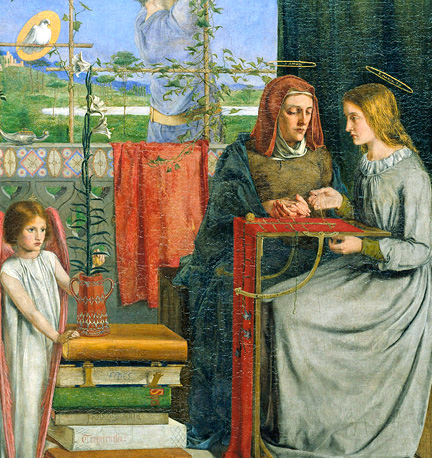
Above: The Girlhood of Mary Virgin’ (1848–9Dante Gabriel Rossetti. Christina Rossetti was used a a model for Mary.
Who Was Christina Rossetti and What Carols did She Write?
Writer of the Text of Two Classic Carols and some new ones
by Ray Rojas
Updated: November 30, 2024.
Editor's Notes: I had been wanting to update this post for quite a sometime because I kept coming across more of Rossetti's Christmas poems that had been set to music. I continue to edit it as I come across more musical settings.
______
Every year, new Christmas carols are solicited from composers, and in turn, these composers scour the literature, mostly poems, new and old, for good Christmas-related texts.
Christina Rossetti was one of those who has written good Christmas texts. She is the writer of the texts used for “In the Bleak Midwinter” and “Love Came Down at Christmas.”
The carols are not sung too much outside of choral circles in the United States, but in the United Kingdom, they are so popular that in 2008, “In the Bleak the Midwinter” was rated the best Christmas carol in a poll of leading choirmasters and choral experts.[1] However, the popularity of "In the Bleak Midwinter" is growing, recently covered by some pop artists on their Christmas albums.
Rossetti was born in London, and she had two siblings, who were also poets. Her brother, Dante Gabriel Rossetti, was a famed artist. While growing up, her parents opened their home to visiting artists and revolutionaries.
As a young woman, Rossetti and her sister became involved in the Anglo-Catholic movement that developed in the Church of England.
An interesting trivia fact is that Christina Rossetti was a model for her brother Dante Gabriel Rossetti’s most famous paintings. These include modeling for the Virgin Mary in his The Girlhood of Mary Virgin. She also modeled for a painting on the Annunciation.
Dante Gabriel Rossetti's "Annunciation"
Around 1842, that Rossetti began dating her poems, some that included Biblical narratives. She published "A Chrismas Carol "(“In the Bleak Midwinter”) in 1872. The poem was first collected in her book Goblin Market, The Prince’s Progress and Other Poems (1875). Rossetti would use the title "A Christmas Carol" for six other poems.
Gustav Holst was the first to set the poem to music. His composition first appeared in The English Hymnal in 1906.
"In the bleak midwinter" by Gustav Holst
Harold Darke wrote an anthem setting in either 1909 or 1911[2]. We know that Darke was at the Royal College of Music at the time. It is worth noting that Darke was the temporary director of the Choir of King’s College, Cambridge during World War II while Boris Ord was in the service. Darke also played with text, censoring the “breastful of milk” phrase. Holst version in The English Hymnal did not censor this. Darke would say later that the carol somewhat pigeonholed him, drawing attention away from his other compositions.
"In the bleak midwinter" by Harold Darke
Of
the other composers who have used the text, Benjamin Britten used the text
combined with aspects of the medieval “Corpus Christi Carol,” in his work A Boy Was Born.
A boy was born, Op. 3 - Variation 5:
In The Bleak Mid-Winter, Benjamin Britten
Other
composers who have taken on the text are Robert C. L. Watson, Bob
Chilcott, Michael John Trotta, Robert Walker,Eric Thiman among others (some listed below).
"Midwinter" by Bob Chilcott
"In the Bleak Midwinter" by Michael John Trotta
"In the Bleak Midwinter" by Robert Walker
"In the Bleak Midwinter" by Eric Thiman
"In the Bleak Midwinter" by Becky McGlade
"Snow had fallen; Christ was born " by Stephen Paulus
Christmas Hath a Darkness: No. 3, In the Bleak Mid-Winter,
Matthew Whittall
An
interesting note is that the editors of the New
Oxford Book of Carols[3]
state, “The free rhythm does not easily lend itself to a single-verse setting
such as Holst’s, but the problem is effortlessly solved in Harold Darke’s
through-composed setting, an object-lesson in multum in parvo.”[4]
"Christmastide" ("Love Came Down at Christmas")
Rossetti’s
poem "Christmastide" from 1885, has also been widely used as a
carol mostly under the title "Love Came Down at Christmas.”
In
1885, the poem was published in Time
Files: A Reading Diary. In 1893, it was included in a collection called Verses, but under the title “Christmastide.”
R.
O. Morris was the first to put a tune to the poem and it was first seen in the English Presbyterian Church Praise (1907)
and then later in Songs of Praise
(1925).
According to the editors of the New
Oxford Book of Carols, “Market research by the 1925 editors (Songs of Praise) had revealed ‘a
strongly felt need for short hymns’, and this was one of the many that were
introduced.”[5]
Morris used the tune “Hermitage,” also known as ‘Gartan’[6] in Irish circles.
"Love Came Down at Christmas" by R.O. Morris
Some
of the composers who have set the text include R.O. Morris, Harold Darke, Leo
Sowerby, Richard Lloyd, Howard Helvey, John Rutter, and Jennifer Higdon who
set the text for solo soprano, harp, and four-part chorus. Below are some compositions:
John Rutter
Leo Sowerby
Richard Lloyd
Howard Helvey
Jennifer Higdon
Matthew Whittall (Christmas Hath a Darkness: No. 4, Love Came Down at Christmas)
Tim Algate
Arlen Clarke
Arr. Edwin Fissinger
David Rasbach (Hal Leonard)
Brian Büda (Hal Leonard)
To tune "Garton"
Text by: Christina G Rossetti 1830-1894 Tune: Garton a traditional Irish melody Source: Methodist 1939 Hymnal #94. This may be R.O. Morris version, but the hymn page does not credit him, but "Garton."
Eleanor Daley Arr. Audrey Snyder
Joel Raney
arr. Edwin Fissinger
David C. Dickau (Pavane Publishing)
David Ashely White
Malcolm Archer
Sonny Salsbury
Christopher Norton
Jessica French
Arr. Stephen Cleobury
Stephen Nash
Matt Oltman
Michael L. Austin
Alexander L'Estrange
Geoffrey Williams (b. 1976)
Matt Maher/Jon Guerra/arr. Ken Litton
Philip Stopford
Ivor Bosanko
Timothy Shaw
Edwin Fissinger
Carson P. Cooman
Bernard Sexton
arr. Stephen Holcomb
Hugh Benham
David Von Kampen
arr. Mary K. Geston
Christopher Maxim
Joanna Forbes L'Estrange
Jonathan Rutherford
Becky McGlade
The 2021 BBC Radio 3 Breakfast Carol Competition used "Love Came Down at Christmas" for their contest. The six finalists were: Helena Davis, Tamiko Dooley, David Harris, Stephanie Spragg, Michelle Turney, and Megan Underhill.
Other Rossetti Christmas Texts (*)
"Holy Innocents"
Rossetti has two poems that she titled "holy Innocents." The most used by composers is the one that begins with "Sleep little baby sleep." Judith Weir used this poem in her 2016 composition. Here is a recording by Vox Feminina:
"Sleep Little Baby, Sleep"
"Commissioned through the generosity of the St Albans Ex-Choristers Association to mark the 20th Anniversary of St Albans Abbey Girls Choir. First performance given by the choir at Evensong on 25th June 2016, conducted by Tom Winpenny. Christina Rossetti (1830-94)"
Original text from poem:
Holy Innocents
Sleep, little Baby, sleep;
The holy Angels love thee,
And guard thy bed,
and keep
A blessed watch above thee.
No spirit can come near
Nor evil beast to harm thee:
Sleep, Sweet, devoid of fear
Where nothing need alarm thee.
The Love which doth not sleep,
The eternal Arms surround thee:
The Shepherd of the sheep
In perfect love hath found thee.
Sleep through the holy night,
Christ-kept from snare and sorrow,
Until thou wake to light
And love and warmth to-morrow.
Stefano Puri also put the poem to music in his carol:
"Holy Innocents" by Stefano Puri
Three Night Songs: I. Holy Innocents by Heather Percy
"Holy Innocents" by Antony Le Fleming
Holy Innocents - Sleep, Little Baby, Sleep - James Prideaux
Sleep, little baby, sleep by Jake Runestad
Four Love Songs: 4. Sleep, little baby, sleep
by Margaretha Christina de Jong
Sleep Little Baby Sleep (2011 Hal Leanard)
by Robert S. Cohen
"Leaf from Leaf Christ Knows"
There is also a piece by Wier on Rossetti's "Leaf from Leaf Christ Knows." It was first performed by the Choir of Well Cathedra in 2016:
Leaf from Leaf Christ Knows, Judith Wier
Original text from poem:
Leaf from leaf Christ knows; / Himself the Lily and the Rose
Leaf from leaf Christ knows;
Himself the Lily and the Rose:
Sheep from sheep Christ tells;
Himself the Shepherd, no one else:
Star and star He names, Himself outblazing all their flames:
Dove by dove, He calls To set each on the golden walls:
Drop by drop, He counts The flood of ocean as it mounts:
Grain by grain, His hand Numbers the innumerable sand.
Lord, I lift to Thee In peace what is and what shall be:
Lord, in peace I trust To Thee all spirits and all dust.
Rossetti's "Christmas Eve" ("Christmas hath a darkness") has been put to music many times. Here is The Sixteen's recording of Kim Porter's musical setting:
Christmas hath a darkness Brighter than the blazing noon, Christmas hath a chillness Warmer than the heat of June, Christmas hath a beauty Lovelier than the world can show: For Christmas bringeth Jesus, Brought for us so low.
Earth, strike up your music, Birds that sing and bells that ring; Heaven hath answering music For all Angels soon to sing: Earth, put on your whitest Bridal robe of spotless snow: For Christmas bringeth Jesus, Brought for us so low. - Christina Rosetti
American composer Arnfield Cudal is among other composers who have written music to the poem:
"Christmas Hath a Darkness" (2016) by Arlen Clarke
"Christmas Eve," Tess Lowe
"Christmas Eve," Jenny Spence
"Christmas Eve" from Hodie by John Priddy
(also with text by William Blake from "Little Lamb")
Christmas Bringeth Jesus, Brad Nix
"Christmas Eve," George Searcy
Christmas Eve, John Martinez
"Christmas Hath a Darkness" by Chaz Bowers
"They have brought gold and spices to my King"
Alison Willis set Rossetti's Epiphany poem "Gold and Spices" to music. It was originally written for the Reading Phoenix Choir (dir. Christpher Hann) and premiered at Reading Minster in December 2019:
"Gold and Spices," Alison Willis
I have yet to see another composer set this text, but I am still searching.
"They have brought us gold and spices to my King:
They have brought gold and spices to my King,
Incense and precious stuffs and ivory;
O holy Mother mine, what can I bring
That so my Lord may deign to look on me?
They sing a sweeter song than I can sing,
All crowned and glorified exceedingly:
I, bound on earth, weep for my trespassing,–
They sing the song of love in heaven, set free.
Then answered me my Mother, and her voice
Spake to my heart, yea answered in my heart:
'Sing, saith He to the heavens, to earth, Rejoice:
Thou also lift thy heart to Him above:
He seeks not thine, but thee such as thou art,
For lo His banner over thee is Love.
-- From The Poetical Works of Christina Georgina Rossetti, with a Memoir and Notes by William Michael Rossetti (1904), page 148.
"Before the paling of the stars"
Amont those who have put Rossetti's poems to music is Derek Healy. He composed "Two Christina Rosetti Carols: 1. Before the paling of the stars," originally titled "A Christmas Carol" by Rosetti.
Before the paling of the stars
Before the winter morn, Before the earliest cock crow, Jesus Christ was born: Born in a stable, Cradled in a manger, In the world his hands had made Born a stranger.
Priest and king lay fast asleep In Jerusalem; Young and old lay fast asleep In crowded Bethlehem; Saint and angel, ox and ass, Kept a watch together Before the Christmas daybreak In the winter weather.
Jesus on his mother's breast In the stable cold, Spotless lamb of God was he, Shepherd of the fold: Let us kneel with Mary maid, With Joseph bent and hoary, With saint and angel, ox and ass, To hail the King of Glory.
Before the winter morn, Before the earliest cock crow, Jesus Christ was born: Born in a stable, Cradled in a manger, In the world his hands had made Born a stranger.
Priest and king lay fast asleep In Jerusalem; Young and old lay fast asleep In crowded Bethlehem; Saint and angel, ox and ass, Kept a watch together Before the Christmas daybreak In the winter weather.
Jesus on his mother's breast In the stable cold, Spotless lamb of God was he, Shepherd of the fold: Let us kneel with Mary maid, With Joseph bent and hoary, With saint and angel, ox and ass, To hail the King of Glory.
Other settings of this poem include:
Before the paling of the stars by John Boda
Before the paling of the stars by Tom Shelton
Before the paling of the stars by Cecilia McDowall
Before the paling of the stars by Joseph M. Martin
Before the paling of the stars by Leo Nestor
Before the paling of the stars by Matthew Brown
Before the paling of the stars by Jerry Wesley Harris
Before the paling of the stars by Paula Foley Tillen
Before the paling of the stars by John Challenger
"The Shepherds had an angel"
Rossetti's poem "A Christmas Carol For My Godchildren"" ("The Shepherds had an angel") has also been put to musical notes.
The Shepherds had an Angel, The Wise Men had a star, But what have I, a little child, To guide me home from far, Where glad stars sing together And singing angels are? –
Lord Jesus is my Guardian, So I can nothing lack: The lambs lie in His bosom Along life's dangerous track: The wilful lambs that go astray He bleeding fetches back.
Lord Jesus is my guiding star, My beacon-light in heaven: He leads me step by step along The path of life uneven: He, true light, leads me to that land Whose day shall be as seven.
Those Shepherds through the lonely night Sat watching by their sheep, Until they saw the heavenly host Who neither tire nor sleep, All singing 'Glory glory' In festival they keep.
Christ watches me, His little lamb, Cares for me day and night, That I may be His own in heaven: So angels clad in white Shall sing their 'Glory glory' For my sake in the height.
The Wise Men left their country To journey morn by morn, With gold and frankincense and myrrh, Because the Lord was born: God sent a star to guide them And sent a dream to warn.
My life is like their journey, Their star is like God's book; I must be like those good Wise Men With heavenward heart and look: But shall I give no gifts to God? – What precious gifts they took!
Lord, I will give my love to Thee, Than gold much costlier, Sweeter to Thee than frankincense, More prized than choicest myrrh: Lord, make me dearer day by day, Day by day holier;
Nearer and dearer day by day: Till I my voice unite, And I sing my 'Glory glory' With angels clad in white; All 'Glory glory' given to Thee Through all the heavenly height.
6 October 1856
One of them is by Maurice Beasley (1888- d. 1945):
"The Shepherds had an angel" by Maurice Beasley
Also, there is a version by "The Shepherds had an angel":
Rossetti wrote several poems that she titled "Advent" and are referred to collectively as her "Advent Poems." Their first lines are "Come, Thou dost say to Angels," "This Advent moon shines cold and clear," and "Earth grown old, yet still so green." Most composers have title them after the first lines. Strangely, "Earth grown old" is neither very festive nor adventy, nevertheless, it has gained composer writing settings for it.
Advent (1851)
'Come,' Thou dost say to Angels,
To blessed Spirits, 'Come':
"Come,' to the lambs of Thine own flock,
Thy little ones, 'Come home.'
'Come,' from the many-mansioned house
The gracious word is sent;
'Com," form the ivory palaces
Unto the Penitent
O Lord, restore us deal and blind,
Unclose our lips though dumb:
Then say to us," I will come with speed,'
And we will answer, "Come.'
This advent poem has been set by Kathryn Rose under the title "Advent."
"Come, thou Dost Say to Angels," Christoffer Woodward (b. 1991)
"Advent," Kathryn Rose
________
Advent (1858)
This Advent moon shines cold and clear,
These Advent night are long;
Our lamps have burned year after year,
And still their flame is strong.
"Watchman, what of the night?" we cry,
Heart-sick with hope deferred:
"No speaking signs are in the sky,"
Is still the watchman's word.
The Porter watches at the gate,
The servants watch within;
The watch is long betimes and late,
the prize is slow to win.
"Watchman, what of the night?" but still
His answer sounds the same:
"No daybreak tops the utmost hill,
Nor pale our lamps of flame."
One to another hear them speak,
The patient virgins wise:
"Surely He is not far to seek,"---
"All night we watch and rise."
"The days are evil looking back,
The coming days are dim;
Yet count we not His promise slack,
But watch and wait for him."
One to another hear them speak,
The patient virgins wise:
“Surely He is not far to seek,”–
“All night we watch and rise.”
“The days are evil looking back,
The coming days are dim;
Yet count we not His promise slack,
But watch and wait for Him.”
One with another, soul with soul,
They kindle fire from fire:
“Friends watch us who have touched the goal.”
“They urge us, come up higher.”
“With them shall rest our waysore feet,
With them is built our home,
With Christ.” “They sweet, but He most sweet,
Sweeter than honeycomb.”
There no more parting, no more pain,
The distant ones brought near,
The lost so long are found again,
Long lost but longer dear:
Eye hath not seen, ear hath not heard,
Nor heart conceived that rest,
With them our good things long deferred,
With Jesus Christ our Best.
We weep because the night is long,
We laugh, for day shall rise,
We sing a slow contented song
And knock at Paradise.
Weeping we hold Him fast Who wept
For us,–we hold Him fast;
And will not let Him go except
He bless us first or last.
Weeping we hold Him fast to-night;
We will not let Him go
Till daybreak smite our wearied sight,
And summer smite the snow:
Then figs shall bud, and dove with dove
Shall coo the livelong day;
Then He shall say, “Arise, My love,
My fair one, come away.”
Rossetti's poem "This Advent Moon Shines Cold and Clear" (see original text below) has also been set to music by Ellen Gilson Voth.
Christmas Hath a Darkness: No. 1 "This Advent Moon"
by Matthew Whittall
---------
Advent
Earth grown old, yet still so green, Deep beneath her crust of cold Nurses fire unfelt, unseen: Earth grown old.
We who live are quickly told: Millions more lie hid between Inner swathings of her fold.
When will fire break up her screen? When will life burst thro' her mould? Earth, earth, earth, thy cold is keen, Earth grown old.
Christmas Hath a Darkness: No. 2, Earth Grown Old, Matthew Whittall
Earth grown old - Martyn Noble
This poem has also been set to music by Stephen Decesare ("Earth Grown Old").
"Christmas Carol 3" "Lo! newborn Jesus"
Composers have hardly touched poems titled "Christmas Carol 1" (Whoso hears a chiming for Christmas at the nighest"), "Christmas Carol 2" (A holy heavenly chime"), and "Christmas Carol 3" ("Lo! newborn Jesus"). SeeThe Poetical Works of Christina Georgina Rossetti, with a Memoir and Notes by William Michael Rossetti (London: Macmillan, 1904), except as noted.
Christmas Carol 3
Lo! newborn Jesus Soft and weak and small, Wrapped in baby's bands By His Mother's hands, Lord God of all.
Lord God of Mary, Whom His Lips caress While He rocks to rest On her milky breast In helplessness.
Lord God of shepherds Flocking through the cold, Flocking through the dark To the only Ark, The only Fold.
Lord God of all things Be they near or far, Be they high or low; Lord of storm and snow, Angel and star.
Lord God of all men, – My Lord and my God! Thou who lovest me, Keep me close to Thee By staff and rod.
Lo! newborn Jesus Loving great and small, Love's free Sacrifice, Opening Arms and Eyes To one and all.
Circa 1887
"Newborn Jesus," Christopher Inman
Lo! New Born Jesus, Barry Ferguson (b 1942)
I am always glad to see modern Christmas texts used for Christmas carols by composers. In the early 1900s, Rossetti’s texts were “modern.”
This shows the need not only for composers to continue new carol writing, but for poets to also continue writing Christmas poems as those poems may be later put music, hopefully of the good kind.
________________________________
* A good reference, which I have noted below is the Christina Rossetti in Music page which can give way more information than this blog post on Rossetti in music. To learn more about the page and its developers, go to:
[6]
Lough Gartan, Co. Donegal. See entry in New
Oxford Book of Carols.
DISCLAIMER: Owner
of photo or photos above is unknown. Infringement is not intentional and photo is
used for educational purposes only with in the Fair Use clause of
Section 107 of the Copyright Act. We will be obliged any take down request under the DMCA.